How Exporters Verify Genuine Mileage on Japanese Export Certificates (Yusshutsu Massho)
By admin · · 10 views
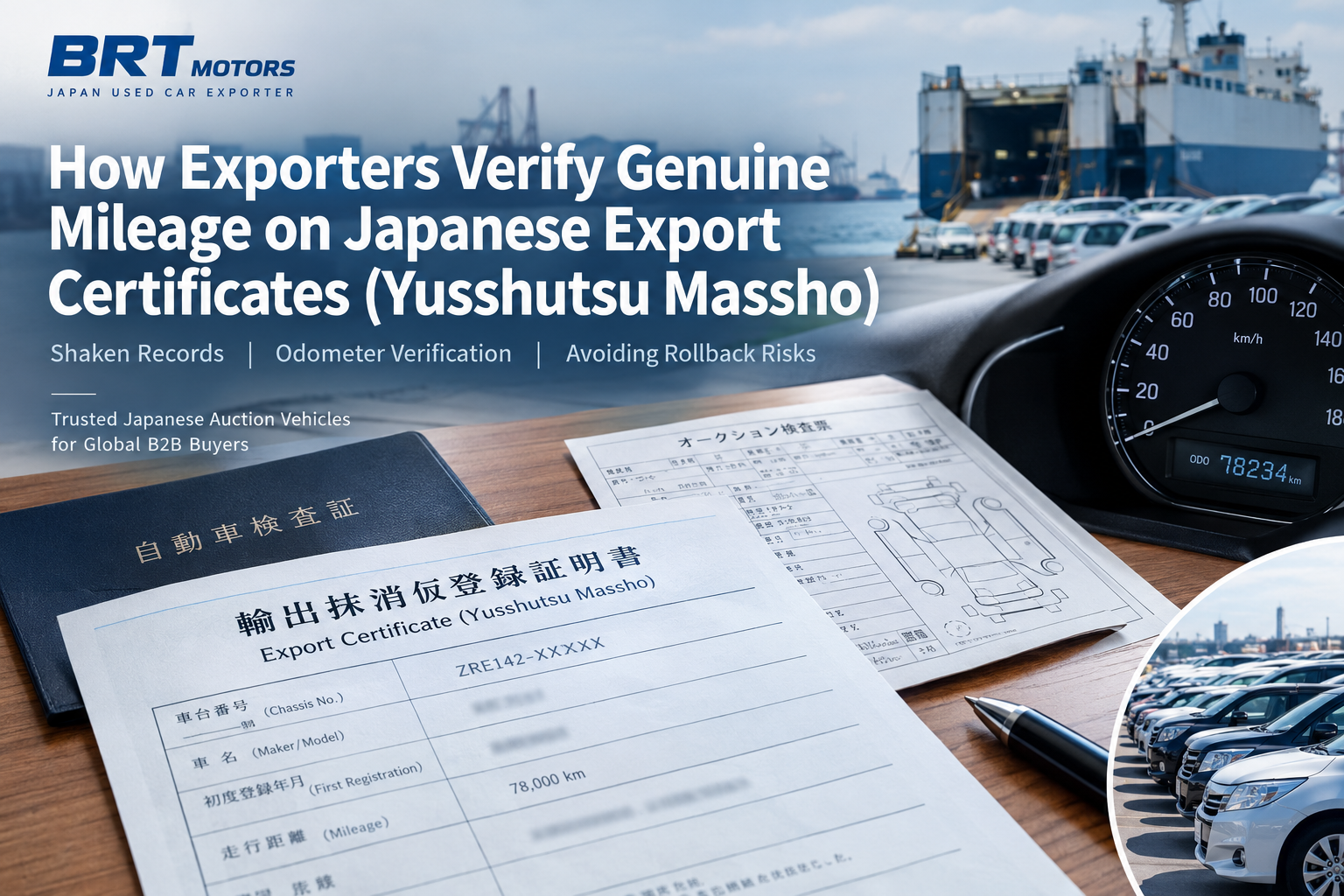
Learn how to check Japanese export certificates, Shaken mileage history, and auction inspection sheets to identify odometer discrepancies before importing used cars from Japan.
Introduction: Why Mileage Verification Matters When Buying Used Cars from Japan
For overseas used-car dealers, mileage is one of the most important factors when evaluating a vehicle sourced from Japan. It affects buyer confidence, vehicle valuation, resale positioning, and the accuracy of the information presented to the next customer.
However, the odometer reading displayed on a dashboard is not, by itself, proof of a vehicle's actual mileage history.
A vehicle may have a low displayed reading but an incomplete maintenance history. Another vehicle may have accumulated higher mileage while remaining in serviceable condition. The challenge for an importer is to distinguish a plausible mileage record from one that contains unexplained gaps or inconsistencies.
One of the most useful documents to review is Japan's vehicle export certificate, commonly referred to as the Yusshutsu Massho (輸出抹消仮登録証明書 or related export-deregistration documentation, depending on the document type and registration circumstances). The exact document name and format can vary, so buyers should check the actual certificate supplied for the vehicle.
Where historical odometer readings are recorded, the certificate can provide useful evidence for comparing mileage at different points in the vehicle's Japanese registration and inspection history.
For professional importers, the best approach is to compare the export documentation with the Japanese auction inspection sheet, available Shaken records, service documents, and the physical condition of the vehicle.
At BRT Motors, based in Osaka, Japan, vehicle sourcing through USS auctions and clear condition documentation are central to our B2B export process. Understanding what mileage records can—and cannot—prove helps overseas buyers make better purchasing decisions.
1. What Is a Japanese Export Certificate (Yusshutsu Massho)?
A Japanese export certificate is a document associated with the deregistration and export process for a vehicle leaving Japan. Buyers may encounter different document names or formats depending on the vehicle's registration status and the applicable administrative procedure.
For used-car importers, the document is important because it helps establish the vehicle's identity and provides registration information relevant to the export transaction.
Depending on the document type and the information recorded, it may include details such as:
Chassis or frame number.
Vehicle model or type information.
First-registration information.
Registration or deregistration details.
Recorded odometer readings associated with relevant inspection or registration events, where applicable.
The exact fields must be checked on the actual document. Not every certificate or translation contains the same information, and a translation may simplify or rearrange the original Japanese entries.
Why the Chassis Number Matters
Before examining mileage, first confirm that the chassis number on the export documentation matches the vehicle being purchased.
Compare it with the number shown on the auction inspection sheet and any other available vehicle records. If the identifiers do not match, resolve the discrepancy before relying on the mileage information.
Mileage records are useful only when they can be reliably connected to the correct vehicle.
2. How Shaken Mileage History Helps Verify a Japanese Used Car
Shaken is Japan's mandatory vehicle inspection system for applicable vehicle categories. Vehicle inspection and registration-related records may contain odometer information, depending on the record and the vehicle's history.
For exporters, historical mileage entries can be particularly useful because they allow a buyer to compare readings recorded at different times rather than relying exclusively on the current dashboard display.
Consider a simplified example:
| Record | Recorded mileage |
|---|---|
| Earlier inspection-related record | 68,000 km |
| Later inspection-related record | 91,000 km |
| Current dashboard reading | 96,000 km |
In this example, the sequence is consistent with mileage increasing over time. It does not, on its own, prove that the vehicle has never been tampered with, but it does not show an obvious numerical reversal either.
Now consider a different example:
| Record | Recorded mileage |
|---|---|
| Earlier inspection-related record | 84,000 km |
| Later inspection-related record | 112,000 km |
| Current dashboard reading | 79,000 km |
The current reading is lower than the later historical record. This is a significant discrepancy that requires investigation before the vehicle is represented as having 79,000 km of total mileage.
Possible explanations must be checked rather than assumed. The issue could involve an odometer replacement, an error in a document or translation, an incorrect vehicle record, or mileage rollback. The numbers alone do not establish which explanation is correct.
The practical rule is simple: historical mileage should be chronologically plausible, and every unexplained reversal should be investigated.
Suggested image placement: A close-up photograph of a Japanese vehicle export certificate beside a vehicle's odometer display. Use a fictional or fully obscured sample document rather than publishing a real customer's identifying information.
3. How to Check for Odometer Tampering on Japanese Export Documents
When evaluating a vehicle, do not focus on one mileage number in isolation. Build a timeline using every reliable record available.
Step 1: Compare the Recorded Mileage Entries
Locate the mileage fields on the original Japanese document and its translation. Check whether the entries are presented as current, historical, inspection-related, or otherwise defined by the document.
Do not assume that two numbers represent the same type of reading unless the labels and document context support that interpretation.
Step 2: Put the Readings in Chronological Order
Arrange the available records by their actual dates or inspection events.
A basic verification table might look like this:
| Date or event | Source | Mileage | Verification note |
|---|---|---|---|
| Earlier inspection | Original record | 54,000 km | Confirm date and vehicle identity |
| Later inspection | Original record | 73,000 km | Compare with previous reading |
| Auction inspection | Auction sheet | 81,000 km | Check inspection date and notation |
| Current dashboard | Physical vehicle | 83,000 km | Record at time of inspection |
The readings in this table are illustrative only. For a real vehicle, use the values shown on the original documents and record the source of each entry.
Step 3: Investigate Reversals and Unexplained Gaps
Mileage deserves further investigation when:
A later record shows a lower reading than an earlier record.
The current odometer is below a reliable historical reading.
A large time gap exists between records and the vehicle's usage cannot be explained.
The auction sheet and export documentation show conflicting readings.
The mileage notation or unit is unclear in a translation.
A gap in records is not automatically evidence of fraud. It means that the available evidence is incomplete and that the buyer should avoid making stronger claims than the records support.
Step 4: Confirm the Original Japanese Wording
Translations can be useful, but they should not replace the original document when a discrepancy arises.
If the mileage field is unclear, compare the translated text with the Japanese source. Ask the document issuer, exporter, or a qualified translator to clarify the relevant field where necessary.
This is particularly important when a buyer is relying on a translated document to make a high-value wholesale purchasing decision.
4. How to Compare the Export Certificate with a Japanese Auction Sheet
A Japanese auction inspection sheet and an export certificate serve different purposes.
The export documentation helps establish registration and export-related information. The auction inspection sheet records information gathered during the auction's vehicle inspection process. Depending on the auction and document, it may include a recorded odometer reading, condition grade, damage map, interior notes, and other observations.
The two sources can complement each other, but they should not be treated as interchangeable.
| Verification item | Export documentation | Auction inspection sheet |
|---|---|---|
| Vehicle identity | Check the recorded chassis or frame number | Check the vehicle details and chassis information provided |
| Mileage evidence | Review historical entries where present | Compare the recorded mileage at auction |
| Exterior condition | Not generally a substitute for a condition report | May record damage and exterior condition |
| Interior condition | Usually not the primary purpose | May include interior condition and related notes |
| Mileage discrepancy | Helps establish historical context | Helps establish the reading recorded at auction |
What If the Two Documents Do Not Match?
First, verify that both documents refer to the same vehicle and that the dates are understood correctly.
Next, check whether the mileage entries use the same units and whether the translated fields have been interpreted correctly.
If the difference remains unexplained, ask the exporter or auction-related contact for clarification and supporting documentation. Do not simply select the lower number because it makes the vehicle appear more attractive to a retail buyer.
For a B2B importer, an unresolved discrepancy is a procurement risk. It should be clarified before the vehicle's mileage is advertised as verified.
5. Can JAAI Appraisal or a Vehicle Inspection Prove Genuine Mileage?
JAAI is associated with vehicle appraisal and inspection services in Japan. However, buyers should not assume that every appraisal or inspection report independently certifies the vehicle's complete lifetime mileage.
The value of an appraisal depends on the specific service performed, the records examined, the inspection scope, and the wording of the resulting report.
When using a JAAI appraisal or another inspection report as part of mileage verification, confirm:
Whether the report records only the odometer reading observed during inspection.
Whether historical records were reviewed.
Whether any mileage discrepancy or uncertainty is explicitly noted.
Whether the report makes a specific statement about mileage authenticity or only describes the vehicle's observed condition.
An inspector recording a dashboard reading of 82,000 km does not necessarily establish that the vehicle has travelled only 82,000 km over its lifetime.
The same distinction applies to a Japanese auction sheet. A recorded odometer value is evidence of the reading observed or reported at that point, but it is not automatically proof of a complete and tamper-free mileage history.
Reliable mileage verification depends on the strength and consistency of the evidence, not simply on the presence of an inspection document.
6. Other Warning Signs Importers Should Investigate
Document checks should be combined with a physical condition review.
Wear That Appears Inconsistent with the Recorded Mileage
Steering-wheel wear, seat bolsters, pedal rubber, switches, and interior trim may provide useful context. However, wear varies with the driver, usage pattern, maintenance, environment, and replacement history.
A worn seat does not prove that a vehicle has high mileage, just as a clean interior does not prove low mileage.
Treat physical wear as a reason to ask questions, not as a standalone mileage test.
Inconsistent Service Records
Where service invoices or maintenance records are available, compare their dates and recorded odometer readings.
A service invoice showing a higher mileage than a later record requires investigation. Confirm that the documents refer to the same vehicle and that the dates and readings have been transcribed correctly.
Odometer Replacement or Instrument-Cluster Repair
An odometer or instrument-cluster replacement may explain a changed reading in some circumstances, but the explanation should be supported by credible records where possible.
Ask for the replacement date, mileage at replacement, and available supporting documentation. If the history cannot be reconstructed, describe the mileage as unverified rather than presenting the displayed figure as confirmed total mileage.
Missing or Conflicting Records
Not every used car will have a complete set of historical documents. Missing records do not automatically mean the vehicle has been tampered with, but they reduce the strength of any claim about genuine total mileage.
A professional importer should distinguish between:
Recorded mileage: A reading shown on a particular document or observed at inspection.
Consistent mileage history: Available readings follow a plausible chronological sequence.
Verified genuine mileage: A stronger claim that requires sufficient supporting evidence and cannot be established by one document alone.
These distinctions help dealers communicate accurately with their own customers.
7. A Practical Mileage Verification Checklist for Wholesale Buyers
Before finalizing a Japanese used-car purchase, use the following checklist.
Match the chassis or frame number across the vehicle and available documents.
Review the original export documentation and its translation.
Identify the historical mileage entries and their corresponding dates or events.
Compare readings in chronological order.
Compare the latest available historical reading with the auction sheet.
Record the current dashboard reading and the date it was observed.
Review service records and other supporting documents where available.
Investigate unexplained mileage reversals or inconsistent entries.
Clarify whether any inspection report evaluates mileage history or only records the observed reading.
Keep copies of the documents used to support the mileage information provided to the next buyer.
For dealers purchasing multiple vehicles, it is useful to keep a separate mileage-verification record for each chassis number. This makes discrepancies easier to identify and reduces the risk of mixing documents between vehicles.
8. How BRT Motors Supports Transparent Japanese Used-Car Sourcing
For overseas dealers, transparent mileage information is part of a broader procurement process. Buyers need to know which records are available, what those records establish, and where further verification is necessary.
BRT Motors is based in Osaka, Japan, and operates as a registered USS auction member. Our vehicles are sourced through USS auction inventory, and we have steadily supplied vehicles to overseas B2B customers.
Our sourcing model is designed to give professional buyers access to Japanese auction vehicles with clear condition information. For vehicles of comparable condition and specification, direct auction sourcing can offer more competitive pricing by reducing unnecessary intermediary layers; the final price still depends on the auction result, vehicle specification, condition, and bidding competition.
For vehicle-condition communication, BRT Motors uses the available Japanese auction inspection report as a key reference and works to ensure that the supplied vehicle corresponds with the condition information documented for the transaction.
Mileage verification requires a separate, evidence-based review. Where export documentation, auction records, or other available documents contain mileage information, buyers should compare the entries and raise any unexplained discrepancy before the vehicle is shipped.
An auction report or export certificate should not be represented as proof of a completely tamper-free lifetime mileage history unless the supporting evidence justifies that claim. Where the records are incomplete, the uncertainty should be made clear.
This approach gives B2B buyers a more reliable basis for evaluating vehicles, comparing purchase options, and communicating vehicle information to their own customers.
9. Frequently Asked Questions
How can I verify genuine mileage on a Japanese used car?
Start by matching the vehicle's chassis number across the available documents. Review historical mileage entries on the export documentation where present, compare them chronologically with auction inspection sheets and service records, and investigate any unexplained reversal. A physical inspection and additional documentation may be needed.
Does a Japanese Export Certificate always show the last two Shaken mileage readings?
Do not assume that every export-related certificate displays exactly two historical Shaken readings. The fields available depend on the document type, vehicle history, and applicable record format. Inspect the actual document and its original Japanese wording to determine what information it contains.
What is Shaken mileage history?
Shaken refers to Japan's vehicle inspection system for applicable vehicle categories. Inspection and registration-related records may provide mileage evidence at particular points in a vehicle's history. The available records should be checked for dates, vehicle identity, and the meaning of each reading.
Can an export certificate prove that a car has never had its odometer rolled back?
No single certificate should automatically be treated as conclusive proof of a completely tamper-free mileage history. Historical readings can reveal inconsistencies, but the strength of the conclusion depends on the completeness and reliability of the available evidence.
What should I do if the auction sheet shows lower mileage than the export records?
Confirm that the documents refer to the same vehicle, compare their dates, and review the original Japanese wording. If the discrepancy remains unexplained, request clarification and supporting evidence before purchasing or advertising the vehicle with a claimed genuine mileage figure.
Is a low-mileage Japanese used car always a better purchase?
Not necessarily. Mileage is only one part of the vehicle's condition. Maintenance history, accident or repair records, corrosion, mechanical condition, usage pattern, model specification, and purchase price all matter. A higher-mileage vehicle with better documentation and maintenance may be a more suitable commercial purchase than a lower-mileage vehicle with unexplained records.
What should an exporter say when the mileage history is incomplete?
State the dashboard reading or the reading recorded on the available inspection report, identify the records that have been checked, and disclose that the complete lifetime mileage history could not be confirmed. Avoid describing mileage as “genuine” or “verified” when the evidence does not support that conclusion.
Conclusion: Verify the Records, Not Just the Dashboard
For professional importers, genuine mileage verification is a process of comparing evidence. Japanese export documentation, Shaken-related history, auction inspection sheets, service records, and physical condition can each contribute useful information, but each has limitations.
The most important warning sign is an unexplained inconsistency between records. When a later reading is lower than an earlier reliable reading, or when documents conflict, investigate before making a purchase decision or passing the mileage claim to another buyer.
BRT Motors supports overseas B2B customers with Japanese USS auction sourcing and condition-focused vehicle documentation. By reviewing the available records carefully and communicating their limitations clearly, buyers can make more informed purchasing decisions and build stronger trust with their own customers.
Looking for Japanese used cars for wholesale export? Contact BRT Motors with your target models, destination market, and sourcing requirements to discuss available vehicles and the documentation that can be reviewed before shipment.