Sourcing Low-Maintenance Commercial Utility Vehicles: Toyota Probox & Succeed Wholesale Guide
By admin · · 43 views
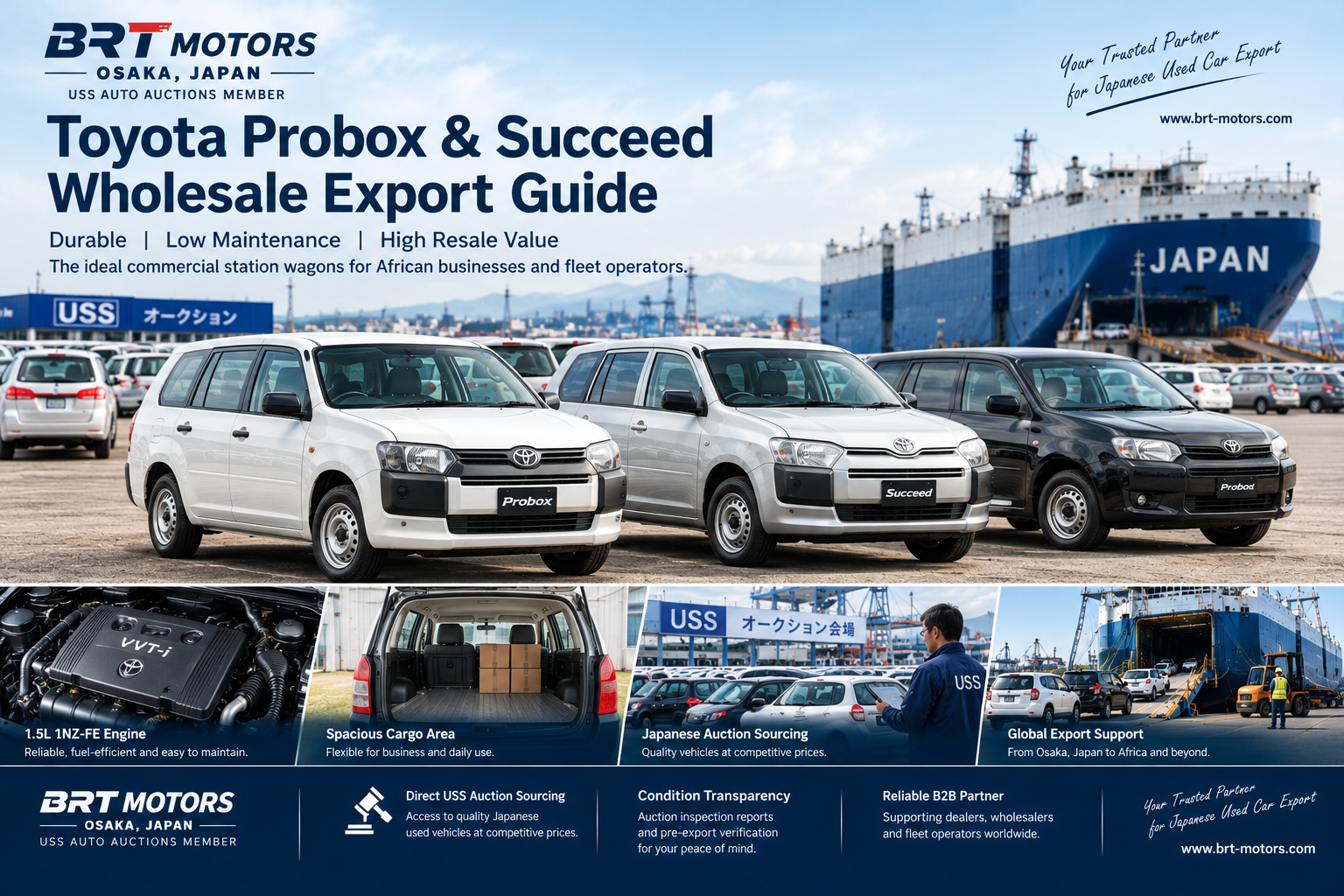
Learn why Toyota Probox NCP160 and Toyota Succeed are popular low-maintenance commercial vehicles for African businesses, fleets and wholesale importers sourcing from Japan.
Sourcing Low-Maintenance Commercial Utility Vehicles: Toyota Probox & Succeed Wholesale Guide
For many small businesses in Africa, the best commercial vehicle is not necessarily the largest van or the most powerful pickup.
It is often the vehicle that can carry goods every day, consume relatively little fuel, survive poor road conditions, remain easy to repair, and keep working without creating excessive maintenance costs.
This is one reason the Toyota Probox and Toyota Succeed have become well-known Japanese commercial station wagons in many African used-car markets.
For importers, wholesalers and fleet operators, these vehicles offer a combination that is difficult to ignore: a practical cargo area, simple mechanical architecture, Toyota parts availability, relatively low operating complexity and strong familiarity among local mechanics.
This guide explains why the Toyota Probox NCP160, Toyota Succeed and related Japanese commercial station wagon configurations are worth considering for wholesale export and commercial fleet procurement.
Why Are Toyota Probox and Succeed Popular Commercial Vehicles?
The Probox and Succeed were designed around a relatively simple idea:
Move people and goods efficiently without unnecessary complexity.
Unlike a large commercial van, a commercial station wagon can be easier to operate in crowded urban areas while still providing substantially more cargo practicality than a conventional sedan.
Typical users include:
- Small wholesalers
- Retail businesses
- Spare-parts distributors
- Hardware suppliers
- Agricultural businesses
- Pharmaceutical and medical distributors
- Courier and delivery companies
- Small logistics operators
- Service technicians
- Construction-material suppliers
- Rental and fleet businesses
- Taxi and passenger transport operators in some markets
The important point for a fleet buyer is that these vehicles are not purchased primarily for luxury.
They are purchased because the vehicle needs to work repeatedly and predictably.
That changes the procurement calculation.
A vehicle with a simple engine, common replacement parts and a large number of mechanics familiar with Toyota systems can sometimes be more valuable to a small business than a newer vehicle with more equipment but higher repair complexity.
Toyota Probox NCP160: A Practical Wholesale Choice
The Toyota Probox NCP160 is one of the most recognizable modern Probox configurations in the Japanese used-car export market.
The model is particularly relevant to buyers looking for a compact commercial vehicle with:
- A practical wagon body
- Large usable cargo space
- Foldable rear seating
- Low loading height compared with many larger vans
- Compact exterior dimensions
- Toyota parts availability
- A petrol engine configuration suitable for everyday commercial use
Many NCP160 Probox vehicles use the 1.5L 1NZ-FE petrol engine, although exact specifications should always be checked against the individual vehicle and auction sheet.
The 1NZ-FE is particularly familiar to mechanics throughout many export markets.
This familiarity matters.
For a fleet operator, the question is not simply:
"How powerful is the engine?"
A better question is:
"How easily can this vehicle be kept running five or seven days a week?"
For commercial fleet procurement, maintenance infrastructure can be as important as the original vehicle specification.
The 1NZ-FE Advantage for Fleet Operators
The 1NZ-FE is a 1.5-liter Toyota petrol engine that has been used across various Toyota models and markets.
Its widespread application means that many mechanics are already familiar with the engine family and its basic maintenance requirements.
For an African small-business fleet, this can provide several practical advantages.
1. Familiar mechanical architecture
A mechanic who already works on Toyota passenger cars may have experience with similar Toyota engine systems.
This reduces the learning curve compared with introducing an unfamiliar vehicle brand or engine family.
2. Parts familiarity
Toyota parts are widely represented in many African automotive markets.
However, buyers should distinguish between:
- Genuine Toyota parts
- OEM-equivalent parts
- Aftermarket parts
- Used parts
Availability and pricing can vary significantly by country.
Therefore, importers should check their own local parts market rather than assuming every component will be equally inexpensive everywhere.
3. Suitable size for daily commercial use
A 1.5-liter petrol engine is not designed to behave like a heavy-duty diesel truck engine.
That is precisely why fleet buyers should use the Probox for the right application.
It is well suited to light commercial transportation, urban deliveries and regular goods movement rather than extremely heavy loads.
Toyota Succeed: The Commercial Wagon Alternative
The Toyota Succeed occupies a similar commercial-utility role.
Depending on production year and configuration, the Succeed was offered in different powertrain and body specifications, so importers should not evaluate the model solely by its name.
The individual vehicle's:
- Model code
- Model year
- Engine
- Transmission
- Drive configuration
- Grade
- Mileage
- Auction grade
- Interior/exterior condition
should all be checked before purchase.
From a fleet perspective, however, the basic appeal is similar to the Probox:
compact dimensions + practical cargo capacity + Toyota mechanical familiarity.
This makes the Probox and Succeed particularly interesting for businesses that need something between a passenger car and a full-size commercial van.
Probox vs Succeed for Commercial Fleet Procurement
For wholesale buyers, the comparison should not be reduced to "which model is better?"
The more useful question is:
Which model fits the customer's operating environment and cargo requirements?
| Procurement Factor | Toyota Probox | Toyota Succeed |
|---|---|---|
| Commercial use | Excellent | Excellent |
| Cargo practicality | Excellent | Excellent |
| Urban maneuverability | Excellent | Excellent |
| Small-business delivery | Excellent | Excellent |
| Fleet operation | Excellent | Excellent |
| Parts familiarity | Strong | Strong |
| Fuel-conscious operation | Suitable | Suitable |
| Heavy-duty hauling | Limited | Limited |
| Passenger-car-like driving | Strong | Strong |
| Used-car wholesale potential | Strong | Strong |
Exact equipment and specifications vary by year and grade, so the auction sheet and vehicle specification should always take priority over a generic model comparison.
Why African Small Businesses Often Prefer This Type of Vehicle
There is a practical reason these vehicles can become known locally as a "workhorse" or even a "神车" — a vehicle that businesses depend on because it simply keeps doing its job.
The appeal comes from the combination rather than from one spectacular specification.
1. It can carry more than a normal sedan
A sedan may be economical, but its trunk opening and rear-seat configuration limit the type of cargo it can carry.
A commercial station wagon provides a much more useful loading area.
For businesses delivering:
- Boxes
- Spare parts
- Tools
- Small equipment
- Food products
- Retail goods
- Documents
- Packages
the difference can be substantial.
2. It is easier to drive in cities than a large van
A small business may need to deliver products to shops, markets, offices and residential areas.
A large van provides more capacity, but it also takes up more road space and can be harder to park.
The Probox/Succeed format gives the operator a compromise between cargo practicality and urban maneuverability.
3. Maintenance infrastructure already exists
A commercial vehicle is only useful when it is available for work.
If a vehicle spends several days waiting for an unfamiliar component or specialist mechanic, the theoretical reliability of the vehicle becomes less important.
Toyota's large installed base in many African countries means that maintenance knowledge is generally easier to find.
This is one of the strongest reasons for considering a Japanese Toyota commercial wagon for fleet procurement.
Payload Capacity: Do Not Confuse a Commercial Wagon with a Truck
One important issue for importers is payload capacity.
The Probox and Succeed are commercial utility vehicles, but they should not be treated as substitutes for a heavy-duty pickup or truck.
Payload depends on the specific vehicle specification, model year and configuration.
Fleet buyers should therefore check the manufacturer's specification or individual vehicle documentation before setting a maximum load requirement.
The practical rule is simple:
Use the Probox or Succeed for light commercial transportation, not as an excuse to overload a compact wagon every day.
Overloading can increase:
- Suspension wear
- Tire stress
- Brake wear
- Fuel consumption
- Transmission load
- Steering and chassis stress
A vehicle that is cheap to maintain can become expensive when consistently operated outside its intended load range.
Why Low Maintenance Cost Matters More Than Purchase Price
For commercial fleet procurement, the initial purchase price is only one part of the calculation.
A more useful model is:
Total Operating Cost = Purchase Cost + Shipping + Local Preparation + Maintenance + Downtime + Fuel + Parts
The exact values vary by country and vehicle, so there is no universal "cheap to run" figure that applies to every market.
But the logic is universal.
Suppose a business buys ten commercial vehicles.
The fleet manager is not only buying ten cars.
The company is buying:
- Ten engines
- Ten transmissions
- Ten suspension systems
- Ten sets of tires
- Ten maintenance schedules
- Ten potential sources of downtime
This is why low-maintenance commercial vehicles can become strategically valuable.
Even a small difference in maintenance frequency or downtime can become significant across a large fleet.
Why Used Japanese Commercial Vehicles Can Make Sense for Wholesale Buyers
Japan has a mature used-vehicle auction ecosystem.
Large auction networks such as USS provide structured vehicle inspections, auction grades and vehicle information that can help overseas buyers evaluate inventory before purchasing.
For an importer, this is important because wholesale procurement should not be based only on photographs.
A proper purchasing process should examine:
- Auction inspection report
- Auction grade
- Interior and exterior condition
- Mileage
- Accident history or repair history indicated by the auction documentation
- Engine and transmission condition
- Undercarriage condition
- Tire condition
- Rust or corrosion
- Existing modifications
- Vehicle year and model code
- Export documentation
The auction sheet should be treated as a key purchasing document rather than an optional piece of information.
Buying Toyota Probox Wholesale from Japan: What Should Importers Check?
If a buyer is sourcing several Probox or Succeed vehicles, purchasing should become a procurement process rather than a one-off car purchase.
1. Establish the exact specification
Do not simply tell a supplier:
"I need Toyota Probox."
Instead specify:
- Model
- Model year range
- Engine
- Transmission
- Drive configuration
- Mileage range
- Auction grade
- Interior condition
- Exterior condition
- Accident/repair requirements
- Color requirements, if relevant
- Quantity
- Destination port
The clearer the specification, the easier it becomes to compare vehicles objectively.
2. Prioritize condition consistency
For fleet procurement, ten vehicles with wildly different conditions may create more problems than ten vehicles with consistent specifications.
A fleet buyer may prefer:
10 vehicles with similar year, mileage and condition
over:
10 vehicles with the lowest possible individual prices.
Consistency simplifies:
- Maintenance
- Driver allocation
- Parts purchasing
- Resale
- Fleet management
- Customer expectations
This is particularly important for companies purchasing vehicles for internal fleets.
BRT Motors: Direct USS Auction Sourcing for B2B Buyers
For overseas buyers looking for Toyota Probox wholesale export from Japan, the sourcing channel matters almost as much as the vehicle itself.
BRT Motors is based in Osaka, Japan, and operates as a registered auction member/registered auctioneer.
The company's Japanese used vehicles are sourced through USS auction inventory and auction yards, allowing BRT Motors to work from actual Japanese auction inventory rather than relying exclusively on layers of domestic vehicle traders.
This is particularly relevant for commercial fleet buyers.
When the buyer specifies something such as:
Toyota Probox NCP160, 1.5L, suitable condition, specified mileage range, wholesale quantity
the procurement process can focus on finding vehicles that meet those requirements through the auction system.
For vehicles with the same or comparable condition and specification, BRT Motors' direct auction sourcing model is intended to provide a lower purchase price by reducing unnecessary intermediary layers.
That is particularly important for fleet orders because a small difference per vehicle becomes more meaningful when purchasing multiple units.
BRT Motors also works with a stable base of B2B customers overseas, so the purchasing process is structured around repeated commercial supply rather than only individual retail exports.
Auction Inspection Report and Vehicle Condition
One of the biggest concerns when purchasing used vehicles internationally is:
"Will the vehicle I receive actually match the vehicle I purchased?"
This is why BRT Motors uses the Japanese auction inspection report as a key reference point for vehicle procurement.
The supplied vehicle is expected to correspond with the condition described in the auction inspection report, rather than treating the auction sheet as merely a sales document.
For buyers, the correct approach is still to review:
- Original auction sheet
- Auction grade
- Damage marks
- Interior/exterior grades
- Mileage
- Auction photographs
- Additional vehicle photographs
- Chassis/undercarriage condition where available
The objective is simple:
The buyer should know what condition they are purchasing before the vehicle leaves Japan.
This is particularly important when purchasing multiple commercial vehicles, because unexpected differences in condition can affect the entire fleet budget.
Why Auction Grade Matters for Probox Wholesale
A Probox with very high mileage and significant cosmetic damage may be cheaper at auction.
But "cheaper" does not automatically mean "better procurement."
A fleet buyer should evaluate the relationship between:
Purchase Price → Condition → Expected Maintenance → Resale Value
For example, a very low-cost vehicle may require more preparation after arrival.
Another vehicle with a somewhat higher auction purchase price may have:
- Better body condition
- Better interior
- Better tires
- Lower mileage
- Cleaner underbody
- Better resale potential
The correct wholesale strategy is therefore not:
Find the cheapest Probox.
It is:
Find the Probox with the best relationship between acquisition cost and usable commercial condition.
Probox for Small Logistics Businesses
For small logistics operators, the Probox/Succeed format can be particularly useful for last-mile and short-distance distribution.
Consider a business supplying products to local retailers.
The vehicle may need to:
- Start early every morning
- Carry cartons or packages
- Stop repeatedly
- Operate in congested streets
- Travel on paved and unpaved roads
- Be loaded and unloaded several times per day
A large truck may be excessive.
A sedan may be insufficient.
A compact commercial wagon occupies the middle ground.
This is one reason the model category has retained strong relevance in used commercial markets.
Probox for Retail and Wholesale Businesses
Small retailers and wholesalers often need a vehicle for their own business rather than for professional logistics.
Examples include:
- Electrical suppliers
- Plumbing businesses
- Hardware shops
- Food distributors
- Agricultural-product dealers
- Auto-parts businesses
- Mobile service technicians
For these businesses, the vehicle itself is a productive asset.
The vehicle does not simply transport the owner.
It enables the owner to:
buy → transport → deliver → sell → collect payment → repeat.
Reliability therefore directly affects business operations.
Probox as a Fleet Vehicle
Fleet procurement requires a different way of thinking from individual car sales.
A fleet manager should consider:
Vehicle standardization
Can the company purchase similar vehicles repeatedly?
Maintenance familiarity
Can local mechanics service the fleet?
Parts availability
Can commonly required parts be sourced without long delays?
Driver usability
Can different drivers operate the vehicle without extensive training?
Cargo practicality
Can the vehicle handle the company's normal load?
Resale
If the fleet is replaced later, is there a recognizable used-car market for the model?
Toyota commercial vehicles can be attractive from this perspective because brand familiarity is already established in many markets.
Are Toyota Probox and Succeed Good for African Roads?
The answer depends on the road and operating conditions.
They are practical commercial wagons, not dedicated off-road vehicles.
For:
- Urban roads
- Highway transportation
- Gravel roads
- Rural business routes
- Moderate poor-road conditions
they can be useful when properly maintained and operated within their load limits.
For severe off-road conditions, deep mud, extremely rocky terrain or heavy cargo, a purpose-built pickup or SUV may be more appropriate.
This distinction is important for importers.
"Durable" does not mean "indestructible."
The right vehicle depends on the actual operating environment.
What Makes a Good Probox Wholesale Stock Unit?
For a dealer importing several units, a practical specification might prioritize:
- Clean auction documentation
- Reasonable mileage
- Good mechanical condition
- Strong body condition
- Acceptable interior condition
- No major structural damage
- Appropriate engine specification
- Good tires or manageable tire replacement requirements
- Suitable cargo configuration
- Consistent specifications across multiple units
The exact buying criteria should be adjusted according to the destination market.
A vehicle intended for resale in a major city may be evaluated differently from one intended for rural commercial operations.
Commercial Fleet Procurement: Buy by Specification, Not by Model Name
One of the biggest mistakes in wholesale vehicle procurement is assuming that every vehicle with the same model name is equivalent.
A Toyota Probox from one auction lot can be significantly different from another Probox because of:
- Year
- Mileage
- Grade
- Accident history
- Maintenance history
- Engine
- Transmission
- Drive configuration
- Interior condition
- Exterior condition
- Previous commercial use
Therefore, professional procurement should create a vehicle specification sheet before bidding.
For example:
Target vehicle:
Toyota Probox NCP160
1.5L
Specified model-year range
Specified mileage range
Auction grade requirement
No major structural damage
Commercial-use specification
Clean inspection documentation
Quantity: fleet order
This makes communication between the importer, auction buyer and final customer much more efficient.
Toyota Probox vs Larger Commercial Vans
Why not simply buy a Toyota HiAce?
Because the two vehicles solve different problems.
A HiAce offers substantially greater carrying and passenger capacity in relevant configurations.
But a small business may not need that capacity every day.
A Probox/Succeed can provide:
- Smaller physical footprint
- Easier urban maneuverability
- Lower vehicle complexity
- Practical cargo space
- Passenger-car-like operation
- Suitable capacity for light commercial work
Therefore:
HiAce = larger commercial transport
Probox/Succeed = compact commercial utility
Neither is universally better.
The correct choice depends on the customer's cargo volume and operating pattern.
Is the Toyota Probox a Good Wholesale Export Product?
For the right destination market, it can be.
The strongest commercial proposition is not simply that the vehicle is inexpensive.
It is that the vehicle combines several characteristics that matter to small businesses:
Durability + Cargo Utility + Toyota Parts Familiarity + Simple Operation + Fleet Suitability
This combination gives the Probox and Succeed a strong argument in markets where buyers prioritize operating cost over luxury equipment.
For exporters, another advantage is that the vehicle is relatively easy to explain to a business buyer.
The buyer understands what it is supposed to do:
Carry goods, move around the city, work every day and remain affordable to maintain.
Frequently Asked Questions
Is the Toyota Probox good for African small businesses?
It can be an effective choice for light commercial transportation, delivery and service businesses where cargo capacity, operating practicality and maintenance accessibility are more important than passenger-car luxury.
What engine does the Toyota Probox NCP160 use?
Many NCP160 configurations use the 1.5L Toyota 1NZ-FE petrol engine. Buyers should confirm the exact engine against the individual vehicle specification and auction documentation.
Is Toyota Succeed the same as Toyota Probox?
They are closely related commercial station-wagon models, but they should not be treated as identical in every year and specification. Model code, engine, grade and equipment should be checked for each vehicle.
Is Probox suitable for heavy loads?
It is designed for light commercial use, not heavy trucking. Buyers should follow the specified payload limits and avoid continuous overloading.
Why are Probox and Succeed popular with commercial users?
Their combination of practical cargo space, compact dimensions, Toyota mechanical familiarity and relatively straightforward maintenance makes them useful for many small businesses and fleet applications.
Can I buy Toyota Probox wholesale from Japan?
Yes. Japanese used-car auction inventory can be an important source for wholesale procurement. The buyer should establish specifications and inspect the auction documentation before bidding.
Where does BRT Motors source its vehicles?
BRT Motors is based in Osaka, Japan, and sources its Japanese used vehicles from USS auction inventory and auction yards as a registered auction member.
Can BRT Motors supply Probox vehicles for a fleet order?
BRT Motors works with B2B customers and can evaluate Japanese auction inventory according to the buyer's target specifications, quantity and condition requirements.
How does BRT Motors handle vehicle condition?
The Japanese auction inspection report is used as a key reference. BRT Motors' procurement process is designed so that the supplied vehicle corresponds with the condition represented in the auction inspection documentation. Buyers should review the original auction sheet and photographs before purchase.
Conclusion: The Best Commercial Vehicle Is the One That Keeps Working
For a small business, a commercial vehicle is not primarily a status symbol.
It is a business tool.
The Toyota Probox and Toyota Succeed have remained relevant because they address a simple commercial requirement:
carry useful cargo, operate every day, remain relatively easy to maintain and avoid unnecessary vehicle complexity.
For African importers and fleet buyers, the Probox NCP160 and related Toyota commercial station wagons can therefore be worth considering when the required application is light commercial transportation rather than heavy-duty trucking.
The most important purchasing decision, however, is not simply choosing the Probox or Succeed.
It is choosing the right individual vehicles at the right acquisition price and with properly documented condition.
For wholesale buyers, sourcing directly through Japan's auction system can help make that process more transparent.
BRT Motors, based in Osaka, Japan, is a registered auction member sourcing vehicles from USS auction inventory and auction yards. With ongoing B2B supply experience, BRT Motors focuses on matching Japanese auction vehicles with overseas commercial requirements. For comparable vehicle condition and specification, the direct auction sourcing model is designed to provide a more competitive price by reducing unnecessary intermediary layers, while the Japanese auction inspection report remains a key reference for vehicle condition.
For a fleet buyer, that combination matters:
the right vehicle + the right condition + the right procurement channel.