Best Budget Commercial Vans from Japan: Toyota HiAce vs Nissan NV350
By admin · · 123 views
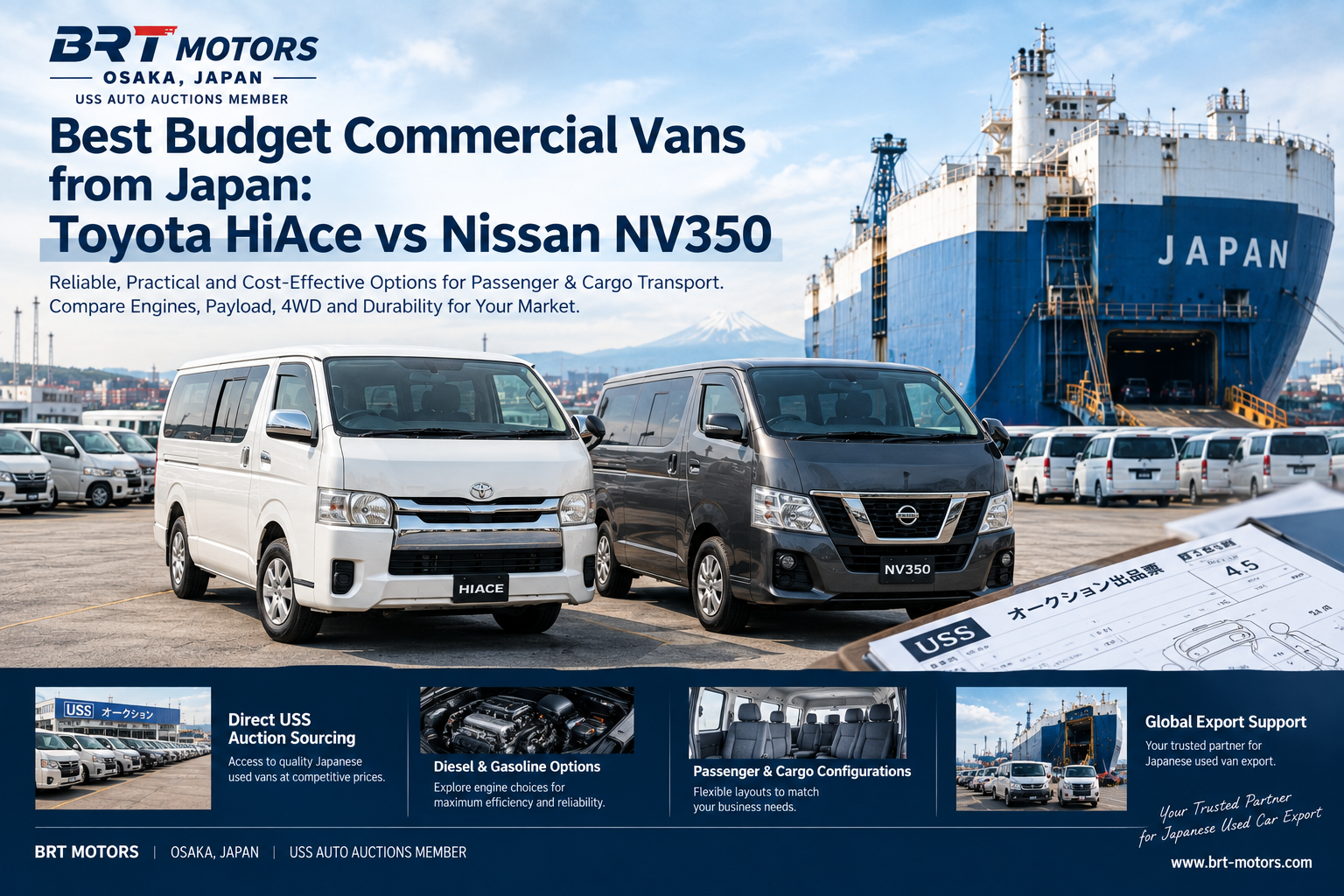
Compare Toyota HiAce vs Nissan NV350 for passenger and cargo transport. Explore diesel and gasoline engines, payload, 4WD, durability and Japanese auction sourcing.
Toyota HiAce vs Nissan NV350 Caravan for Passenger and Cargo Transport | RHD Japanese Used Vans for Export
For commercial vehicle dealers and fleet operators in Africa, the Caribbean, Southeast Asia and other RHD markets, Japanese used vans offer a practical combination of durability, parts support and flexible configurations.
Among the most important models in the Japanese used-van market are the Toyota HiAce and Nissan NV350 Caravan.
Both are available in passenger and cargo configurations, and both have been produced with diesel and gasoline engines across different generations and specifications.
But which one makes more sense for a commercial operator?
The answer depends on how the van will be used.
A passenger transport operator may prioritize seating capacity, cooling, suspension durability and long-distance reliability. A cargo operator may care more about payload, loading dimensions, fuel consumption and drivetrain durability.
This guide compares the Toyota HiAce vs Nissan NV350 Caravan from a B2B export perspective, focusing on engine choices, payload, durability, RHD suitability, maintenance, parts availability and Japanese auction sourcing.
Toyota HiAce vs Nissan NV350: Quick Comparison
| Category | Toyota HiAce | Nissan NV350 Caravan |
|---|---|---|
| Main role | Passenger and commercial transport | Passenger and commercial transport |
| Japanese-market availability | Very strong | Strong |
| RHD availability | Yes | Yes |
| Diesel options | Available across multiple generations | Available across multiple generations |
| Gasoline options | Available | Available |
| Passenger configurations | Extensive | Extensive |
| Cargo configurations | Extensive | Extensive |
| 4WD availability | Available on selected versions | Available on selected versions |
| Commercial reputation | Very strong | Strong |
| Parts ecosystem | Strong in many export markets | Strong in many markets |
| Best purchasing method | Condition + specification comparison | Condition + specification comparison |
The important point is that neither model should be evaluated only by its name.
A HiAce 3.0 diesel and a HiAce 2.0 gasoline are not the same commercial proposition.
Likewise, an NV350 with a diesel engine, a gasoline engine and a 4WD configuration can have significantly different operating characteristics.
1. Toyota HiAce: The Japanese Commercial Van Benchmark
The Toyota HiAce has been produced in numerous generations and configurations and has become one of the most recognizable Japanese commercial vans internationally.
For overseas B2B buyers, the attraction is not simply the Toyota badge.
HiAce is available in configurations designed for:
- Passenger transportation
- Cargo transportation
- Tourism
- Shuttle services
- Construction businesses
- Logistics
- Hotel transportation
- Minibus applications
- Fleet operations
The Japanese domestic market also provides a large range of used HiAce vehicles with different combinations of:
- Wheelbase
- Roof height
- Body length
- Engine
- Transmission
- Seating configuration
- 2WD/4WD
- Equipment
- Mileage
- Auction grade
This makes HiAce particularly suitable for buyers who want to specify a vehicle rather than simply purchase whatever happens to be in stock.
2. Toyota HiAce Diesel Engines
One reason HiAce is popular among commercial operators is the availability of diesel powertrains across multiple generations.
Important diesel engines encountered in Japanese used HiAce sourcing include:
1KD-FTV 3.0 Diesel
The 1KD-FTV is a 3.0-liter turbocharged diesel engine associated with various Toyota commercial and passenger vehicles.
In the HiAce/RegiusAce family, it is particularly relevant to buyers looking at earlier 200-series vehicles.
Its characteristics include:
- 3.0-liter displacement
- Turbocharged diesel
- Strong low-speed torque
- Commercial-duty application
- Good suitability for loaded operation
For used-vehicle buyers, however, engine reputation should never replace an inspection of the individual vehicle.
A high-mileage 1KD-FTV with poor maintenance is still a used engine that requires inspection.
1GD-FTV 2.8 Diesel
The 1GD-FTV became an important newer-generation Toyota diesel powertrain and appears in later HiAce applications.
Compared with older diesel generations, the 1GD platform represents Toyota's newer diesel technology and is relevant to buyers looking for newer HiAce vehicles.
When comparing a 1KD HiAce with a 1GD HiAce, dealers should consider:
- Model year
- Mileage
- Transmission
- Vehicle condition
- Emissions configuration
- Intended destination market
- Parts availability
- Purchase price
The newest engine is not automatically the most profitable vehicle for an importer.
3. Toyota HiAce Gasoline Engines
Diesel is not the only option.
Japanese-market HiAce vehicles have also been offered with gasoline engines, including:
- 1TR-FE 2.0-liter gasoline
- 2TR-FE 2.7-liter gasoline
depending on generation and configuration.
Gasoline HiAce vehicles can make sense where:
- Annual mileage is relatively low
- Diesel availability is less convenient
- Initial purchase price matters
- The vehicle operates mainly in urban environments
- Local fuel pricing favors gasoline
- The customer does not regularly carry heavy loads
This is an important point for exporters.
Commercial vehicle selection should be based on the customer's operating cycle, not simply on the assumption that diesel is always better.
4. Nissan NV350 Caravan: The Main Alternative
The Nissan NV350 Caravan was introduced as a major successor to the E25-generation Caravan and became an important competitor to the HiAce in Japan.
It is available in both:
- Passenger-oriented configurations
- Commercial cargo configurations
and can be found with different engines, transmissions, wheelbases and drivetrain configurations.
For overseas buyers, its biggest attraction is straightforward:
It can provide many of the functions expected from a Japanese commercial van while sometimes offering a different price point in the used market.
This makes NV350 particularly interesting for dealers who want to compare vehicles by actual auction price and condition rather than automatically selecting Toyota.
5. Nissan NV350 Diesel Engines
One of the key diesel engines associated with the NV350 Caravan is the YD25DDTi 2.5-liter turbo diesel.
For commercial users, diesel's main attraction is its torque characteristics and suitability for regular loaded operation.
A cargo operator carrying equipment every day has different requirements from a hotel shuttle carrying passengers on paved roads.
When evaluating a used NV350 diesel, inspect:
- Engine condition
- Turbocharger-related condition
- Cooling system
- Transmission
- Oil leakage
- Suspension
- Underbody
- Service history where available
- Auction inspector comments
Again, the engine code alone does not determine whether an individual vehicle is a good purchase.
6. Nissan NV350 Gasoline Engines
NV350 Caravan has also been available with gasoline engines, including 2.0-liter and 2.5-liter gasoline configurations depending on specification.
For buyers who do not require heavy daily loading, a gasoline van can sometimes be a reasonable alternative.
The decision should consider:
Annual mileage × fuel consumption × fuel price × purchase price × maintenance requirements
rather than simply asking whether diesel or gasoline is "better."
7. HiAce vs NV350: Diesel or Gasoline?
This is one of the most important decisions for commercial buyers.
Diesel makes more sense when:
- The vehicle travels long distances
- The vehicle regularly carries heavy loads
- The vehicle operates as a commercial fleet vehicle
- Torque under load is important
- Annual mileage is high
Gasoline can make more sense when:
- Mileage is relatively low
- The vehicle is mainly urban
- Loads are moderate
- Initial purchase cost is a major factor
- Local gasoline availability is better
There is no universal answer.
A tourism company running a passenger shuttle 300 days a year has different requirements from a small business using its van twice a week.
8. Payload: Do Not Confuse "Big Van" With "High Payload"
Payload is one of the most misunderstood specifications in used commercial vans.
A simple way to understand the relationship is:
Payload ≈ Gross Vehicle Weight − Vehicle Curb Weight
But the actual permissible payload depends on the exact vehicle specification.
It can vary according to:
- Body length
- Wheelbase
- Roof configuration
- Engine
- Transmission
- 2WD/4WD
- Seating configuration
- Number of passengers
- Vehicle equipment
- Japanese-market classification
This is why quoting a single "HiAce payload" or "NV350 payload" without identifying the exact model is potentially misleading.
A cargo van designed for commercial loading will have a different usable capacity from a passenger van with multiple rows of seats.
9. Passenger Capacity Is Also a Business Calculation
For passenger transport operators, seating capacity is often more important than cargo payload.
A van can be used for:
- Airport transfers
- Hotel shuttles
- Safari/tourism operations
- School transportation
- Staff transportation
- Public transport
- Intercity passenger services
In these applications, the operator should evaluate:
- Number of seats
- Interior configuration
- Air conditioning
- Roof height
- Door configuration
- Luggage capacity
- Suspension condition
- Tire condition
A nominally cheaper cargo van may not be the right purchase if the customer's business requires passenger transportation.
10. HiAce vs NV350 for Passenger Transport
For passenger operations, both models have relevant configurations.
Toyota HiAce
Potential advantages include:
- Extensive passenger-van history
- Large global Toyota ecosystem
- Many configuration choices
- Strong recognition among commercial operators
Nissan NV350 Caravan
Potential advantages include:
- Competitive used-market availability
- Multiple passenger configurations
- Diesel and gasoline choices
- 2WD and selected 4WD versions
The right decision should therefore be made by comparing specific vehicles, rather than comparing two model names in isolation.
For a dealer, this is particularly important because the price difference between two individual auction vehicles can sometimes be more commercially significant than the difference between Toyota and Nissan.
11. Which Is More Durable: HiAce or NV350?
This question is common, but it needs to be answered carefully.
Both are commercial vehicles designed for demanding use.
Toyota has a particularly strong reputation for commercial vehicles internationally, while Nissan Caravan has also been used extensively for commercial and passenger applications.
But "durability" is not a permanent property of a badge.
A used commercial van's actual condition depends on:
- Mileage
- Maintenance
- Previous operating environment
- Loading history
- Accident history
- Rust
- Suspension wear
- Transmission condition
- Engine condition
- Previous repairs
For example:
A well-maintained NV350 with a clean inspection history can be a better commercial purchase than a poorly maintained HiAce.
The same principle applies in reverse.
12. Why Japanese Auction Grade Matters
Japanese auctions provide an important advantage for overseas B2B buyers: vehicles can be evaluated using structured inspection information before purchase.
For a commercial van, buyers should look beyond the overall grade.
Check:
Exterior
- Scratches
- Dents
- Paint condition
- Rust
- Previous repairs
Interior
- Seat condition
- Dashboard
- Commercial wear
- Odors
- Missing equipment
Mechanical
- Engine comments
- Transmission
- Suspension
- Oil leaks
- Warning lights where documented
Underbody
- Rust
- Damage
- Leakage
- Structural condition
- Signs of severe use
For commercial vans, the underbody deserves particular attention because these vehicles may have spent years carrying passengers or cargo.
13. Why Auction Mileage Matters
Mileage is particularly important for commercial vans.
A van used for commercial transportation can accumulate significant mileage.
But mileage alone should not determine the purchase.
Consider two vehicles:
Van A
180,000 km
Well maintained
Clean auction sheet
Good drivetrain
Good interior
No significant structural concerns
Van B
110,000 km
Poor maintenance history
Body repairs
Underbody corrosion
Transmission concerns
The lower-mileage vehicle is not automatically the better commercial asset.
For B2B buyers, the more useful question is:
What condition am I actually buying for the money?
14. 4WD HiAce and NV350: Are They Worth Buying?
For markets with poor roads, 4WD can be valuable.
Japanese-market HiAce and Caravan models are available in selected 4WD configurations.
This can be useful for:
- Rural transportation
- Mountain areas
- Construction
- Tourism
- Remote communities
- Areas with seasonal poor road conditions
However, 4WD also adds complexity and can affect:
- Purchase price
- Fuel consumption
- Maintenance
- Drivetrain components
- Tire requirements
If the customer spends almost all of the time on paved roads, 4WD may not generate enough practical benefit to justify the additional cost.
15. HiAce vs NV350 for African Markets
African commercial vehicle markets are highly diverse.
A vehicle suitable for an urban fleet in one country may not be appropriate for a rural operator in another.
Urban Passenger Transport
Consider:
- HiAce
- NV350
Prioritize:
- Passenger capacity
- Air conditioning
- Fuel consumption
- Maintenance
- Interior durability
Rural Passenger Transport
Consider:
- 4WD versions where genuinely required
- Higher-clearance configurations
- Strong suspension
- Good underbody condition
Cargo Transport
Prioritize:
- Cargo body configuration
- Payload
- Wheelbase
- Loading access
- Suspension
- Engine condition
Tourism
Prioritize:
- Passenger comfort
- Air conditioning
- Luggage space
- Reliability
- Long-distance driving condition
16. What About the Caribbean?
The Caribbean is also an important RHD market, but not every Caribbean country uses RHD vehicles.
This distinction matters.
Before sourcing, an exporter should confirm:
- Steering configuration requirements
- Import regulations
- Age restrictions
- Emissions requirements
- Vehicle inspection requirements
- Local registration requirements
For RHD Caribbean markets, Japanese commercial vans can be attractive because Japan itself has a large RHD used-vehicle market.
HiAce and Caravan can therefore be considered for:
- Passenger transport
- Tourism
- Hotel shuttle services
- Construction
- Delivery
- Small businesses
But the target country's specific regulations should always be checked before purchasing.
17. Parts Availability: Toyota vs Nissan
Parts availability is often one of the most important factors for commercial operators.
A vehicle that is inexpensive to purchase but difficult to repair can become expensive over its operating life.
Toyota's global presence gives HiAce an important advantage in many markets.
The model has been sold across a wide range of countries, and Toyota commercial vehicles are familiar to many independent mechanics.
Nissan also has a broad international presence, and Caravan/NV350 parts can be sourced through Nissan channels and independent suppliers in many markets.
However, parts availability should be checked by country and model generation.
Do not assume that a part available for a locally sold model will automatically fit a Japanese domestic-market vehicle.
The chassis code, engine code and production year can be important when identifying replacement parts.
18. Which Van Is Better for a Small Dealer?
For a small dealer entering the Japanese used-van market, there is a temptation to choose whichever model has the lowest auction price.
A better approach is to calculate expected resale value.
For example:
Expected gross margin = Expected resale price − Total landed cost
Total landed cost should account for the costs applicable to the specific transaction, including the vehicle purchase, logistics, export-related charges and destination costs.
There is no universal fixed shipping or import cost because the result depends on:
- Origin
- Destination
- Shipping method
- Vehicle dimensions
- Shipping schedule
- Local taxes
- Customs rules
- Port charges
Therefore, a cheap auction purchase does not automatically mean a profitable export vehicle.
19. How BRT Motors Sources HiAce and NV350
For overseas B2B customers, BRT Motors operates from Osaka, Japan, and is a registered auction member.
The company's vehicle sourcing is based on USS auction inventory.
This is particularly relevant when customers are looking for commercial vans because the Japanese auction market allows buyers to search according to specific requirements instead of depending entirely on fixed dealer stock.
For example, an overseas dealer can specify:
Toyota HiAce
Diesel
RHD
Passenger configuration
Specific model year range
Target mileage
Acceptable auction grade
2WD or 4WD
Maximum purchasing budget
The same process can be applied to Nissan NV350 Caravan.
This changes the purchasing process from:
"Show me your cheapest van."
to:
"Find me the right van for my market."
That distinction is important for commercial buyers.
20. Why Direct Auction Sourcing Can Improve Pricing
There are multiple layers of cost in the used-car supply chain.
A vehicle can move through:
Auction → Trader → Stockist → Exporter → Overseas Dealer
Every additional commercial layer can potentially add margin.
BRT Motors sources vehicles through its USS auction membership and works directly with overseas B2B buyers.
For vehicles of comparable condition, this direct sourcing model is intended to provide more competitive pricing by reducing unnecessary intermediary layers.
The actual auction purchase price still depends on:
- Vehicle condition
- Mileage
- Model
- Specification
- Auction competition
- Market demand
Therefore, the correct comparison is not simply:
HiAce vs NV350
but:
Specific HiAce vs specific NV350 + actual condition + actual auction price + actual destination market.
21. BRT Motors' Condition Verification
Price is only one part of commercial vehicle sourcing.
For a dealer buying from overseas, another major concern is whether the vehicle received actually corresponds with the information used to make the purchasing decision.
BRT Motors uses the Japanese auction inspection report as a key reference when purchasing vehicles.
The company's purchasing and export standard is that the supplied vehicle should correspond with the condition described in the inspection report.
This is particularly important for commercial vans because body damage, interior wear and mechanical issues can directly affect resale value.
For buyers who cannot inspect the vehicle personally in Japan, the original auction documentation becomes an important part of the purchasing process.
22. A Practical HiAce vs NV350 Buying Checklist
Before bidding on either vehicle, overseas dealers should check:
Vehicle
- Model year
- Chassis code
- Engine code
- Mileage
- Transmission
- 2WD/4WD
- Body length
- Roof configuration
- Seating configuration
Condition
- Auction grade
- Interior grade
- Exterior condition
- Repair history
- Rust
- Underbody
- Suspension
- Engine
- Transmission
- Tires
Business suitability
- Passenger or cargo use
- Expected annual mileage
- Typical load
- Local road conditions
- Local fuel availability
- Local parts availability
- Expected resale price
Export suitability
- RHD requirement
- Destination regulations
- Import age requirements
- Shipping method
- Total landed cost
This checklist is more useful than simply asking whether HiAce or NV350 is "better."
23. Related Japanese RHD Commercial Vehicle Searches
Buyers researching Japanese vans often search across several related categories.
Top reliable RHD commercial vans from Japan export
The Toyota HiAce and Nissan Caravan/NV350 are important models to investigate, but the appropriate choice depends on the destination market and intended use.
Other Japanese commercial vehicles may also be relevant depending on payload, passenger capacity and budget.
Best RHD Japanese SUVs for rough roads
Commercial operators sometimes need an SUV rather than a van.
For rough-road applications, models such as:
- Toyota Land Cruiser Prado
- Toyota RAV4
- Subaru Forester
- Nissan X-Trail
- Mitsubishi Pajero
can be evaluated according to drivetrain and road conditions.
4WD RHD Toyota models for off-roading
For buyers specifically searching for RHD Toyota 4WD vehicles, potential candidates include:
- Land Cruiser
- Land Cruiser Prado
- Hilux
- Hilux Surf
- Selected HiAce configurations
The exact 4WD specification must always be confirmed on the individual vehicle.
Most fuel-efficient RHD hatchbacks from Japan
Customers who do not require a commercial van may instead consider compact Japanese hatchbacks such as:
- Toyota Aqua
- Toyota Yaris
- Honda Fit
- Nissan Note
- Suzuki Swift
These vehicles serve a very different purpose from HiAce and NV350 but may be more appropriate for urban fleets where passenger capacity and cargo volume are less important.
Best RHD hybrid cars under USD 5,000
This is another separate category frequently considered by importers.
Toyota Aqua, Prius, Honda Fit Hybrid and Nissan Note e-Power can appear in Japanese used-car sourcing discussions.
However, a fixed USD 5,000 purchase threshold cannot guarantee a suitable vehicle because auction prices vary according to year, mileage, grade, condition and market demand.
24. Final Verdict: HiAce or NV350?
For B2B buyers, the question should not be:
"Which van is universally better?"
Instead, ask:
"Which specific vehicle provides the right combination of condition, specification, price and operating characteristics for my market?"
Toyota HiAce
A strong candidate when the buyer prioritizes:
- Global Toyota recognition
- Commercial-vehicle reputation
- Broad configuration choices
- Parts and service familiarity in many markets
- Long-term fleet use
Nissan NV350 Caravan
A strong candidate when the buyer wants:
- A Japanese commercial van alternative to HiAce
- Diesel or gasoline choices
- Passenger and cargo configurations
- Competitive used-market options
- Selected 4WD configurations
For a dealer, the final choice should be made by comparing individual auction vehicles, not just catalog specifications.
A clean NV350 with the correct configuration may be a better purchase than an overpriced HiAce.
Likewise, a well-maintained HiAce with a suitable diesel configuration may provide better long-term value than a cheaper vehicle with an uncertain history.
FAQ
Is Toyota HiAce better than Nissan NV350?
Both are established Japanese commercial vans. HiAce has particularly strong international recognition, while NV350 Caravan provides a competitive alternative.
The actual vehicle condition, engine, configuration and purchase price should be compared before making a decision.
Which is better for passenger transport?
Both models have passenger configurations. The decision should consider seating capacity, air conditioning, luggage requirements, road conditions and local regulations.
Which is better for cargo?
Both offer cargo configurations. The correct comparison requires checking the exact body length, wheelbase, GVW, curb weight and permitted payload of the individual vehicle.
Is diesel better than gasoline for a commercial van?
Not universally.
Diesel can be advantageous for high-mileage and regularly loaded operation, while gasoline can be suitable for lower-mileage or predominantly urban applications.
Are HiAce and NV350 available in 4WD?
Yes, selected Japanese-market configurations of both model families have been offered with 4WD. The exact drivetrain must be confirmed for each vehicle.
Can I buy a Japanese HiAce or NV350 through auction?
Yes. Japanese auction inventory includes many commercial vans, with availability depending on the auction, model, specification and timing.
Does a high auction grade guarantee a perfect van?
No.
The auction grade should be considered together with the inspection sheet, damage diagram, mileage, comments, mechanical information and photographs.
Why buy through BRT Motors?
BRT Motors is based in Osaka, Japan, operates as a registered auction member, and sources vehicles through USS auctions.
For overseas B2B customers, this provides access to Japanese auction inventory rather than relying solely on fixed stock.
BRT Motors also places emphasis on matching the supplied vehicle's condition with the auction inspection report. For vehicles of comparable condition, its direct auction sourcing model is designed to provide competitive pricing.
Conclusion
The Japanese used commercial van market offers overseas dealers more choices than simply selecting the cheapest available vehicle.
Toyota HiAce and Nissan NV350 Caravan are both important candidates for passenger and cargo applications, but the best vehicle depends on the actual business requirement.
For passenger transport, evaluate:
seating + air conditioning + comfort + suspension + reliability.
For cargo operations, evaluate:
payload + body dimensions + drivetrain + engine + suspension.
For rough-road operation, evaluate:
ground clearance + 4WD + underbody condition + suspension + tires.
For fleet economics, evaluate:
purchase price + fuel + maintenance + parts availability + resale value.
And for Japanese used-vehicle sourcing, always evaluate the individual auction vehicle, not merely the model name.
BRT Motors, based in Osaka, Japan, supports overseas B2B buyers by sourcing Japanese used vehicles through USS auctions and comparing available vehicles according to model, specification, mileage, auction grade and condition.
For dealers looking for HiAce, NV350 Caravan, Japanese commercial vans, RHD SUVs or other Japanese used vehicles, the most effective purchasing strategy is to define the market requirement first and then search the Japanese auction market for the right vehicle.