Top 5 High-Demand Sedans & Station Wagons for East African Showrooms
By admin · · 86 views
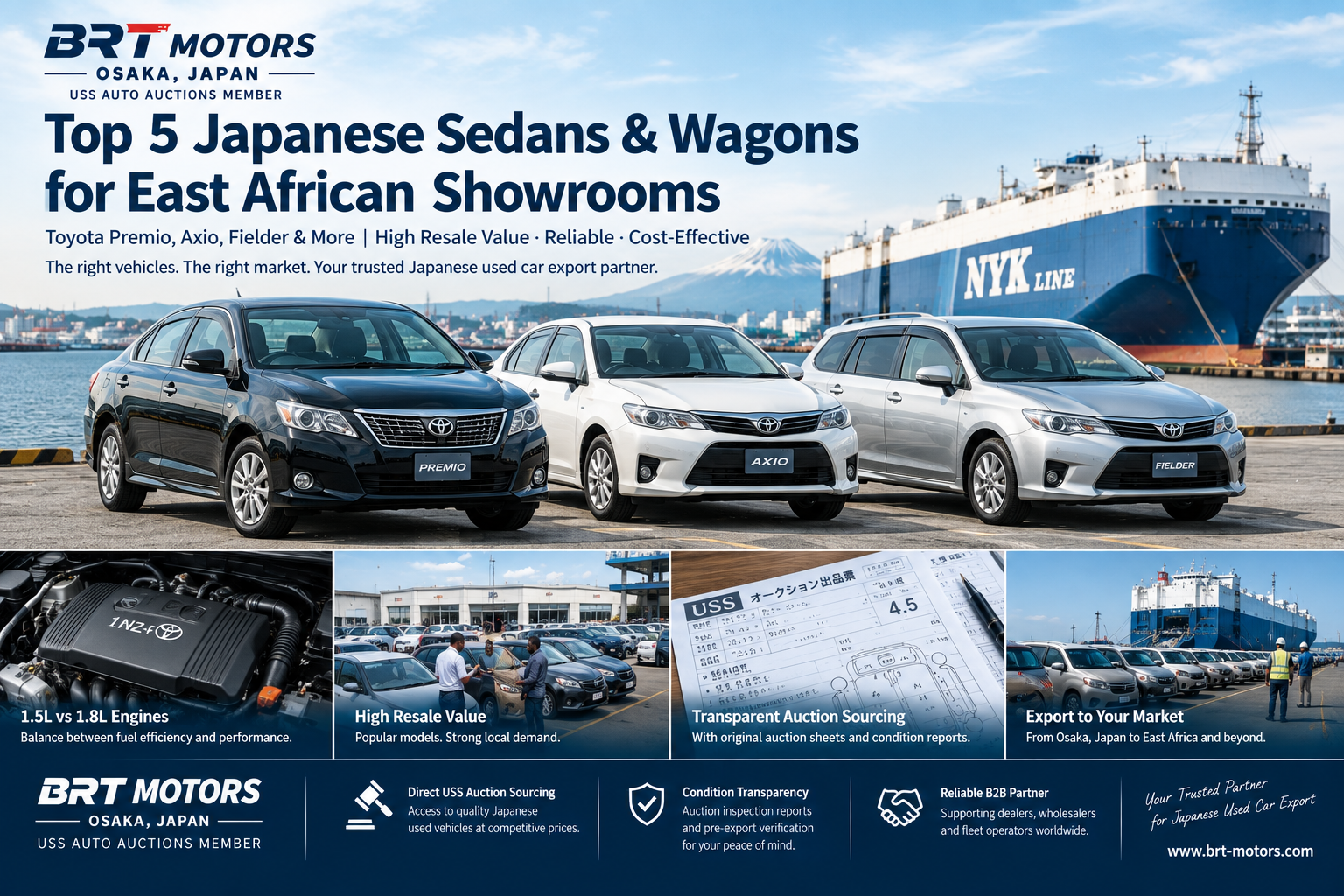
Compare Toyota Premio, Corolla Axio, Fielder and other Japanese used cars for Kenya and Uganda dealers. Explore 1.5L vs 1.8L engines, resale value, parts and wholesale sourcing.
Toyota Premio, Corolla Axio, Fielder & Other Japanese Used Cars for Kenya and Uganda Dealers
For a used-car dealer in East Africa, buying a vehicle is only the first step.
The real business question is:
How quickly can this vehicle be sold, at what margin, and with how much after-sales risk?
This is why Japanese used sedans and station wagons remain important inventory choices for dealers serving markets such as Kenya and Uganda.
Models such as the Toyota Premio, Toyota Corolla Axio and Toyota Corolla Fielder combine familiar Toyota engineering, practical dimensions, relatively straightforward maintenance and strong recognition among used-car buyers.
For wholesalers and showroom operators, however, model popularity alone is not enough.
The more important factors are:
- Purchase price
- Vehicle condition
- Engine specification
- Fuel consumption
- Spare-parts availability
- Customer demand
- Resale value
- Inventory turnover
- Target customer
- Total landed cost
This article examines five Japanese passenger-car choices that can be considered for East African showroom inventory, with particular attention to Toyota Premio, Corolla Axio and Corolla Fielder.
The 5 Models at a Glance
| Model | Body Type | Typical Engine Options | Main Commercial Advantage |
|---|---|---|---|
| Toyota Premio | Sedan | 1.5L / 1.8L / other configurations by generation | Comfortable sedan with strong Toyota recognition |
| Toyota Corolla Axio | Sedan | 1.5L / 1.8L depending on generation | Compact, practical and economical |
| Toyota Corolla Fielder | Station Wagon | 1.5L / 1.8L depending on generation | Cargo flexibility + passenger use |
| Toyota Allion | Sedan | 1.5L / 1.8L / 2.0L depending on generation | Larger sedan alternative to Axio |
| Toyota Corolla | Sedan / related body styles | Multiple engines depending on market and generation | Broad global recognition and parts ecosystem |
Specifications vary by model year, Japanese-market grade and drivetrain. Dealers should verify the exact chassis code, engine code, transmission and equipment before purchasing.
1. Toyota Premio
A Strong Sedan for Customers Looking Beyond Compact Cars
The Toyota Premio is one of the most recognizable Japanese domestic-market sedans among used-car importers in East Africa.
Its appeal is different from that of a small economy sedan.
Premio provides a more substantial passenger-car package while retaining Toyota's reputation for practical maintenance and everyday usability.
For showroom operators, this can make Premio attractive to customers who want:
- A comfortable family sedan
- A larger interior than a compact sedan
- Good highway usability
- Toyota brand recognition
- Reasonable operating costs
- A vehicle suitable for both private and business use
Premio is particularly relevant when the customer wants something more upscale than a basic compact sedan but does not want to move into the price and running-cost category of a large SUV.
Premio and Resale Value
A vehicle's resale value is not determined by its original Japanese market position alone.
In an export market, resale depends on several factors:
Model recognition + condition + mileage + specification + local demand + parts availability.
This is why a clean Premio with an appropriate specification can be attractive inventory for a dealer.
The important word is clean.
A showroom customer is more likely to care about:
- Exterior condition
- Interior condition
- Mileage
- Accident history
- Engine condition
- Transmission
- Air conditioning
- Overall appearance
than the auction grade number by itself.
2. Toyota Corolla Axio
Compact, Practical and Easy to Position
The Toyota Corolla Axio is another important Japanese domestic-market sedan.
Compared with Premio, Axio is generally positioned as a more compact and practical vehicle.
That can be an advantage for East African dealers.
A significant portion of the used-car market is not looking for a large vehicle.
Customers may prioritize:
- Fuel economy
- Affordable purchase price
- Easy maneuverability
- Toyota reliability
- Simple maintenance
- Availability of replacement parts
For this customer group, Corolla Axio can be a logical showroom product.
3. Toyota Corolla Fielder
Why Station Wagons Matter to Dealers
The Corolla Fielder is particularly interesting because it combines passenger-car characteristics with useful cargo capacity.
That makes it more versatile than a conventional sedan.
A Fielder can appeal to:
- Families
- Small businesses
- Sales representatives
- Contractors
- Farmers
- Delivery users
- Estate and property businesses
- Customers who need additional luggage space
This flexibility is valuable for showroom inventory.
A sedan has a relatively clear customer profile.
A station wagon can potentially serve several customer groups.
Fielder vs Axio
The two models share important Corolla-family characteristics but serve different practical requirements.
Corolla Axio
More suitable for customers prioritizing:
- Compact size
- Sedan styling
- Daily commuting
- Fuel economy
- Easy urban driving
Corolla Fielder
More suitable for customers prioritizing:
- Cargo space
- Family use
- Luggage
- Business equipment
- Flexible passenger/cargo use
For a dealer, this means they do not necessarily compete directly.
A showroom can potentially stock both because they address different customer requirements.
4. Toyota Allion
A Larger Sedan Alternative
The Toyota Allion is another Japanese domestic-market sedan that can be considered when a dealer wants a vehicle positioned between compact sedans and larger executive-style cars.
Depending on generation, Allion has been offered with engines including 1.5L, 1.8L and 2.0L configurations.
This gives dealers multiple specification possibilities.
However, the exact engine and drivetrain should always be confirmed from the individual Japanese auction listing.
Allion can be interesting for customers who want:
- More cabin space
- Sedan comfort
- Toyota recognition
- Practical ownership
- A vehicle that looks more substantial than a compact sedan
5. Toyota Corolla
The Global Name With Local Recognition
Toyota Corolla needs little introduction.
Unlike Premio, Axio and Fielder, Corolla has a much broader international market presence.
This can be particularly useful for dealers because customers may already be familiar with:
- Toyota Corolla
- Corolla engines
- Toyota maintenance
- Toyota replacement parts
- Toyota service networks
However, "Corolla" covers many generations, body styles, engines and market specifications.
A Japanese domestic-market Corolla should therefore not automatically be treated as identical to the locally sold Corolla in the destination country.
For parts ordering, the following information can be important:
- Model code
- Chassis code
- Engine code
- Production year
- Generation
- Transmission
This is especially important when importing Japanese domestic-market vehicles.
1.5L vs 1.8L: Which Engine Should East African Dealers Buy?
This is one of the most useful questions for showroom inventory planning.
The simple answer is:
1.5L is generally more focused on economy, while 1.8L provides additional performance and carrying capability.
But the actual difference depends on the vehicle generation, transmission, drivetrain, vehicle weight and driving conditions.
1.5L Engines
The Toyota 1NZ-FE is particularly relevant when discussing Japanese used vehicles with 1.5L gasoline power.
It has been used across numerous Toyota models and has a long history in the Japanese market.
For dealers, its commercial advantages can include:
- Familiar Toyota engine family
- Relatively compact displacement
- Practical fuel consumption
- Large historical installation base
- Broad mechanic familiarity in many markets
The 1.5L category is particularly interesting for customers who spend most of their time driving in urban areas.
Why 1.5L Can Be Attractive for High-Turnover Inventory
Suppose a showroom serves customers who primarily need:
- Daily commuting
- Family transportation
- City driving
- Moderate highway travel
A 1.5L sedan may provide enough performance without requiring the customer to move into a larger engine category.
This can potentially expand the number of customers who can afford the vehicle's operating costs.
For a dealer, that matters.
A car that appeals to a broader practical customer segment can be easier to position in inventory.
But this should be treated as a market-specific commercial hypothesis, not a guarantee of faster sales.
Actual turnover depends on the dealer's location, pricing, vehicle condition and customer base.
1.8L Engines
The 1.8L category offers additional displacement and generally more power than a comparable 1.5L configuration.
This can be useful for customers who regularly drive:
- Long distances
- Highways
- Hilly roads
- Heavier passenger loads
- More demanding operating conditions
The 1.8L engine may also be more appropriate when customers prioritize acceleration and highway performance.
However, the trade-off can include higher fuel consumption depending on the exact vehicle.
Again, there is no universal fuel-consumption figure that applies to every 1.8L Toyota.
1.5L vs 1.8L: Commercial Comparison
| Factor | 1.5L | 1.8L |
|---|---|---|
| Purchase positioning | Often easier to position as an economy choice | More performance-oriented |
| Urban driving | Very suitable | Suitable |
| Highway driving | Suitable | More performance margin |
| Fuel economy focus | Generally stronger | Generally lower than comparable 1.5L |
| Heavy passenger/load use | More limited | Generally better suited |
| Maintenance familiarity | Strong on common Toyota engines | Strong on common Toyota engines |
| Target buyer | Economy-focused customer | Performance/comfort-focused customer |
The actual result depends on the individual vehicle.
What About the 1NZ-FE Engine?
The 1NZ-FE is an important entity for Japanese used-car SEO because it appears across multiple Toyota models.
It is a 1.5-liter gasoline engine from Toyota's NZ engine family and has been used in numerous Toyota passenger cars.
For an importer, the value of a familiar engine is not simply technical.
It can also influence:
- Mechanic familiarity
- Parts sourcing
- Used-parts availability
- Repair knowledge
- Customer confidence
This is one reason engine selection should be considered alongside the vehicle model.
Fuel Consumption: Why You Should Not Publish One Universal Number
A common mistake in used-car marketing is writing:
"The 1.5L gets X km/L and the 1.8L gets Y km/L."
This can be misleading.
Real-world fuel consumption depends on:
- Vehicle generation
- Engine
- Transmission
- Vehicle weight
- Tire size
- Traffic
- Road conditions
- Driving style
- Air-conditioning use
- Vehicle condition
A Japanese laboratory test result is also not necessarily the same as actual fuel consumption in Nairobi, Kampala or another East African city.
For B2B dealers, it is safer to use relative positioning:
1.5L → generally economy-focused
1.8L → generally performance-focused
Then evaluate the actual specification.
Why Parts Availability Matters for Resale
A vehicle's resale value is partly connected to the ownership experience after the sale.
Imagine two vehicles with similar purchase prices.
Vehicle A
- Common engine
- Common Toyota platform
- Many local mechanics understand it
- Replacement parts are relatively easy to source
Vehicle B
- Less common specification
- Specialized parts
- Fewer local mechanics familiar with the vehicle
- More difficult parts identification
Even if Vehicle B looks attractive in the showroom, it may be harder for a customer to own.
This is why parts availability can influence resale demand.
Showroom Inventory Turnover
For a dealer, inventory turnover is more important than simply having a large stockyard.
The basic concept is:
Inventory Turnover = Vehicles Sold ÷ Average Inventory
The higher the turnover, the more efficiently the dealer is using working capital.
Consider two inventory strategies.
Strategy A
Stock 20 vehicles.
Most are unusual specifications with limited customer demand.
Some remain unsold for months.
Strategy B
Stock 20 vehicles.
Most are familiar models with clearly defined customer segments.
Vehicles are priced according to market demand and replaced as they sell.
The second strategy can potentially use working capital more efficiently.
This is why high-demand Japanese models can be attractive to showroom operators.
Why Toyota Premio Can Work in a Showroom
Premio can occupy the customer segment between basic compact sedans and larger premium vehicles.
A dealer can position it toward customers looking for:
- Family transportation
- Comfort
- Toyota reliability
- More interior space
- Better highway usability
Its showroom value comes from being recognizable while still feeling more substantial than a basic compact sedan.
Why Axio Can Work in a Showroom
Axio can be positioned around:
Economy + Toyota + compact size + practical ownership.
This can make it particularly relevant for:
- First-time buyers
- Commuters
- Small families
- Business users
- Fleet customers
For dealers targeting price-sensitive buyers, 1.5L Axio configurations can be particularly relevant.
Why Fielder Can Be a Strong Commercial Product
Fielder has one feature that sedans cannot easily reproduce:
a practical station-wagon cargo area.
This makes it suitable for customers who need one vehicle for several purposes.
For example:
A customer may use it during the week for business equipment and on weekends for family transportation.
That dual-purpose capability can make the vehicle easier to market to practical buyers.
Kenya: What Should Dealers Consider?
Kenya is a major destination market for Japanese used vehicles and has a strong ecosystem around Japanese brands.
For Kenyan dealers considering Premio, Axio and Fielder, relevant purchasing considerations include:
- RHD configuration
- Local vehicle regulations
- Vehicle age requirements
- Engine size
- Condition
- Mileage
- Local parts availability
- Resale demand
- Import costs
- Port and inland logistics
A dealer should not assume that a model popular in one Kenyan showroom will automatically have the same demand in another customer segment.
Location and retail price matter.
Uganda: Resale and Practical Ownership
Ugandan dealers also need to consider more than the auction purchase price.
Customers may evaluate:
- Fuel economy
- Ground clearance
- Reliability
- Spare parts
- Repair costs
- Interior space
- Vehicle appearance
- Resale potential
This makes practical Japanese sedans and station wagons relevant to the market.
For a dealer, the key is matching the vehicle specification with the customer's actual use.
Wholesale Toyota Premio Japan
The search term "wholesale Toyota Premio Japan" reflects an important B2B purchasing requirement.
A wholesale buyer usually does not need one particular vehicle.
They need a repeatable supply channel.
For example, a dealer may specify:
Premio
1.5L or 1.8L
RHD
Selected model years
Grade 4 or above
Target mileage
Clean condition
FOB shipment
Multiple units
This is fundamentally different from purchasing a single retail vehicle.
The supplier needs to be able to repeatedly search Japanese auction inventory and provide suitable vehicles.
Toyota Corolla Fielder Bulk Buy
The same principle applies to the search term:
"Toyota Corolla Fielder bulk buy."
A bulk buyer should not necessarily request:
"Give me 10 Fielder."
A more useful purchasing specification is:
Fielder
1.5L
RHD
Target model years
Target mileage
Acceptable auction grade
Maximum FOB budget
Quantity required per month
This gives the Japanese sourcing side a measurable purchasing target.
It also reduces the risk of receiving ten vehicles with completely different conditions.
How BRT Motors Sources These Vehicles
BRT Motors is based in Osaka, Japan and operates as a registered auction member.
The company's Japanese used vehicles are sourced from USS auction inventory.
This is particularly useful for B2B buyers because the objective is not simply to sell vehicles already sitting in stock.
Instead, the sourcing process can begin with the buyer's requirement.
For example:
Kenya dealer requirement
Toyota Premio
1.5L
RHD
Clean condition
Target mileage
Target auction grade
FOB budget
BRT can then search suitable USS auction inventory according to those requirements.
The same approach can be used for:
- Corolla Axio
- Corolla Fielder
- Allion
- Corolla
- HiAce
- NV350
- SUVs
- Other Japanese used vehicles
Why USS Auction Sourcing Matters
Japanese auction sourcing gives buyers access to a large range of individual used vehicles.
The important advantage is vehicle-level selection.
Two Toyota Premio vehicles can have completely different:
- Mileage
- Auction grade
- Repair history
- Interior condition
- Exterior condition
- Equipment
- Tires
- Previous usage
A dealer should therefore evaluate the actual auction vehicle rather than purchasing purely according to model name.
BRT Motors and Price Transparency
For overseas dealers, the purchase price is obviously important.
BRT Motors' business model is based on sourcing vehicles through USS auctions rather than simply adding multiple layers of dealer stock.
For vehicles with comparable condition and specification, this direct auction sourcing structure is intended to provide a more competitive purchasing price by reducing unnecessary intermediary margins.
The actual auction price can still vary because of:
- Auction competition
- Mileage
- Grade
- Model year
- Vehicle specification
- Market demand
- Individual vehicle condition
Therefore, a credible wholesale quotation should always be connected to an actual vehicle or clearly defined purchasing specification.
BRT Motors and Vehicle Condition
Price alone does not build a sustainable B2B relationship.
For an overseas dealer, receiving a vehicle that does not match the auction description can create:
- Reconditioning costs
- Customer complaints
- Delayed sales
- Reputation problems
- Unexpected capital requirements
BRT Motors therefore uses the Japanese auction inspection report as an important reference when sourcing vehicles.
The company's requirement is that the supplied vehicle should correspond with the condition described in the inspection report.
For buyers who cannot inspect vehicles personally in Japan, this is an important part of reducing purchasing uncertainty.
The buyer should still review the original auction sheet, photographs and available vehicle information before confirming a purchase.
How to Build a High-Turnover East African Showroom
A showroom does not necessarily need to stock every type of Japanese vehicle.
A more practical approach is to divide inventory into customer segments.
Economy Segment
Possible vehicles:
- Corolla Axio 1.5L
- Other compact Toyota sedans
- Fuel-efficient Japanese hatchbacks
Target customers:
- Commuters
- First-time buyers
- Budget-conscious families
Family Sedan Segment
Possible vehicles:
- Toyota Premio
- Toyota Allion
- Larger Corolla configurations
Target customers:
- Families
- Professionals
- Business owners
Practical Cargo / Family Segment
Possible vehicle:
- Toyota Corolla Fielder
Target customers:
- Small businesses
- Families
- Contractors
- Salespeople
- Customers requiring additional luggage space
How Dealers Should Compare Two Auction Cars
Imagine a dealer is choosing between:
Premio A
Grade 4
120,000 km
1.5L
Good interior
Minor exterior scratches
Premio B
Grade 4.5
95,000 km
1.8L
Very clean interior
Higher auction price
Which should the dealer buy?
There is no automatic answer.
The dealer should ask:
What does my customer actually want?
If the local market is strongly price-sensitive, Premio A may provide better inventory economics.
If customers are willing to pay more for newer-looking, lower-mileage vehicles, Premio B may generate better retail positioning.
This is why resale value cannot be separated from acquisition cost.
FOB Bulk Purchasing: What Dealers Should Clarify
If a Kenyan or Ugandan dealer wants to place a bulk FOB order, the purchasing specification should be clear.
For example:
Model
Toyota Premio / Axio / Fielder
Steering
RHD
Engine
1.5L / 1.8L
Condition
Specified auction grade and acceptable damage
Mileage
Specified maximum or target range
Quantity
Monthly or quarterly requirement
Shipping
FOB basis with the agreed Japanese port
Documentation
Required export and vehicle documentation
The actual FOB quotation should then be based on the specific vehicle selection and current logistics conditions.
This is more reliable than publishing a fixed generic FOB price.
Common Mistakes When Buying Japanese Sedans for Africa
Mistake 1: Buying Only on Price
The cheapest auction car may not have the best resale potential.
Mistake 2: Buying Only on Auction Grade
Grade 4 does not tell the entire story.
Read the inspection sheet.
Mistake 3: Assuming 1.5L Is Always Better
1.5L can be attractive for economy, but some customers need the additional performance of 1.8L.
Mistake 4: Ignoring Parts
A cheap vehicle becomes less attractive if the customer cannot easily maintain it.
Mistake 5: Buying Too Many Similar Cars
If all inventory targets the same customer group, the dealer may increase stock concentration risk.
Mistake 6: Treating Japan Domestic Models as Identical to Local Models
Chassis codes and specifications matter.
Always confirm compatibility before ordering parts.
FAQ
Which Toyota sedan sells well in East Africa?
Toyota models are widely recognized in East African used-car markets, but actual sales demand varies by country, customer segment, pricing and vehicle condition.
Premio, Axio and other Corolla-family vehicles can be considered by dealers targeting different customer groups.
Is Toyota Premio good for Kenya?
Premio can be a practical option for Kenyan dealers targeting customers who want a comfortable Toyota sedan.
The specific vehicle's age, condition, engine, mileage and purchase price should be evaluated before importing.
Is Corolla Fielder good for Uganda?
Fielder's combination of passenger seating and flexible cargo space can make it suitable for customers who need a multipurpose vehicle.
Actual resale demand depends on local pricing and customer preferences.
Is 1.5L better than 1.8L for African markets?
Neither is universally better.
1.5L is generally more suitable for buyers emphasizing economy and urban use, while 1.8L can be more appropriate for customers who prioritize additional performance or regularly drive with heavier loads.
Is the 1NZ-FE a reliable engine?
The 1NZ-FE has a long history across Toyota applications and is widely recognized as a practical Toyota 1.5L gasoline engine.
However, the condition of an individual used engine depends on its mileage, maintenance and previous use.
Can I buy Toyota Premio wholesale directly from Japan?
Yes. Japanese auction sourcing allows B2B buyers to search for Premio vehicles according to model year, engine, mileage, auction grade and other requirements.
BRT Motors sources vehicles through USS auction inventory from its base in Osaka.
Can BRT Motors supply Corolla Fielder in bulk?
BRT Motors can source Japanese used vehicles according to defined B2B purchasing requirements.
For bulk orders, the most useful specification includes the desired model, engine, model year, mileage, auction grade, condition and target purchasing budget.
Final Thoughts
For an East African showroom, the best inventory is not necessarily the vehicle with the highest specification.
The more useful question is:
Which vehicle can be purchased at the right condition and price, sold to a clearly defined customer group, and supported after the sale?
Toyota Premio, Corolla Axio and Corolla Fielder each serve different purposes.
Premio can target buyers looking for a comfortable and more substantial sedan.
Axio can target customers who prioritize practical size and economy.
Fielder can target buyers who need both passenger transportation and useful cargo space.
Allion provides another sedan option for customers wanting a larger Toyota package.
Corolla provides broad international recognition and a large Toyota ecosystem, although the exact Japanese-market specification must be checked.
For dealers comparing 1.5L vs 1.8L, the decision should be based on the actual customer and operating environment rather than engine displacement alone.
For wholesale buyers, the most important principle is even simpler:
Buy the right individual vehicle, not simply the right model.
BRT Motors operates from Osaka, Japan, as a registered auction member and sources vehicles through USS auctions.
For overseas B2B customers, this allows vehicle sourcing to begin with a defined requirement rather than a fixed stock list.
For vehicles with comparable condition and specification, BRT Motors' direct USS auction sourcing model is designed to provide competitive pricing by reducing unnecessary intermediary layers.
At the same time, BRT Motors places importance on the vehicle matching the Japanese auction inspection report, giving overseas buyers a clear reference when evaluating condition before shipment.
For Kenya, Uganda and other RHD markets, a sustainable Japanese used-car business is ultimately built on three things:
Competitive acquisition + predictable vehicle condition + strong local resale demand.
That is the foundation of showroom inventory turnover.