Top 7 Most Durable RHD Japanese SUVs for African & Caribbean Roads
By admin · · 118 views
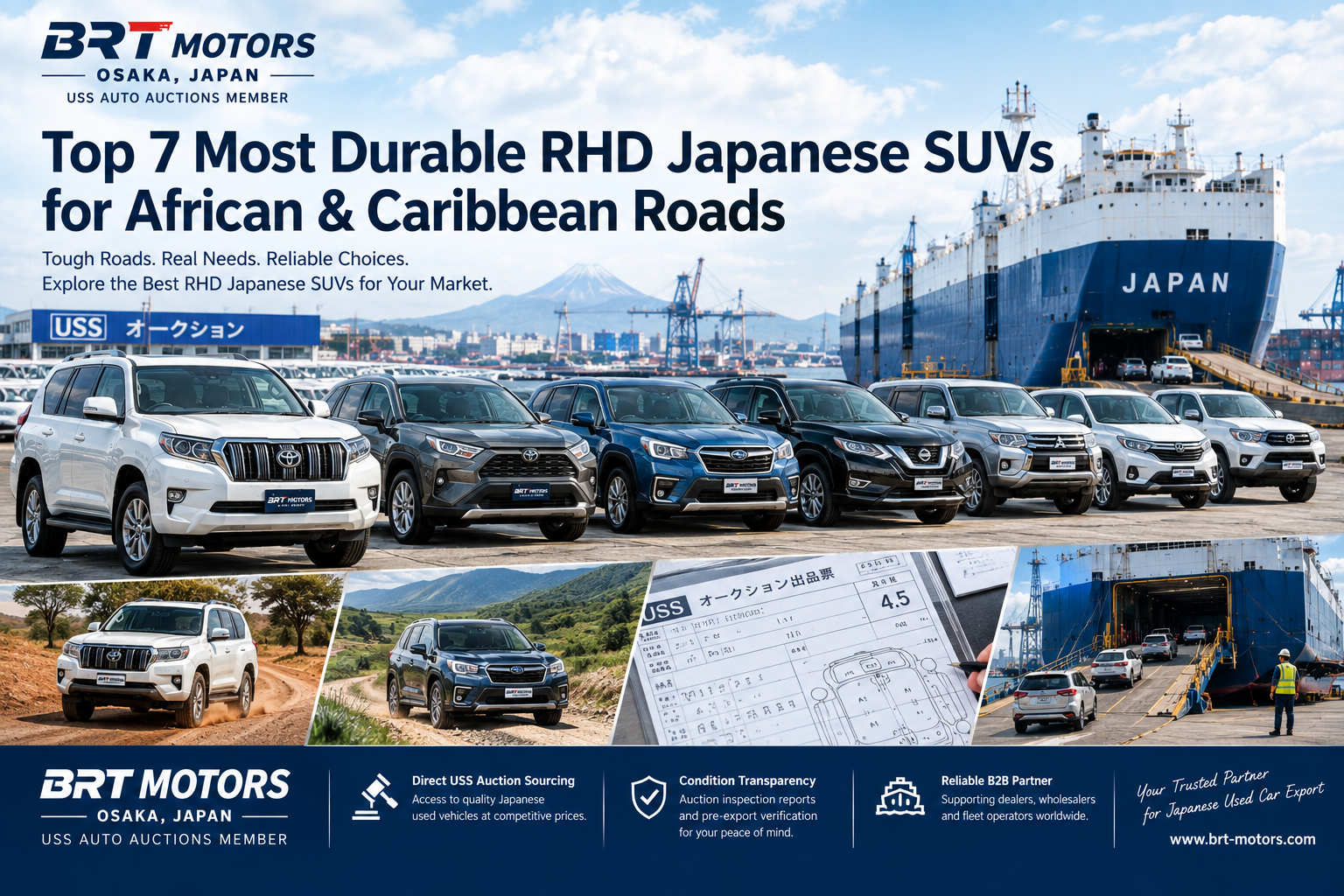
Compare the top RHD Japanese SUVs for rough African and Caribbean roads, including Prado, RAV4, Forester, X-Trail, Pajero, CR-V and Hilux Surf.
For dealers and importers looking for Japanese used SUVs for Africa and the Caribbean, the question is not simply which SUV has the highest specification.
A vehicle that performs well on a smooth highway may not be the best choice for roads with potholes, loose gravel, mud, uneven surfaces, steep slopes, or frequent heavy loading.
For RHD markets, Japanese used SUVs remain particularly relevant because Japan has a large domestic used-car market, a mature vehicle inspection and auction system, and a long history of producing practical four-wheel-drive and all-wheel-drive vehicles.
This guide examines seven RHD Japanese SUVs that are commonly considered for demanding road conditions:
- Toyota Land Cruiser Prado
- Toyota RAV4
- Subaru Forester
- Nissan X-Trail
- Mitsubishi Pajero
- Honda CR-V
- Toyota Hilux Surf
The comparison focuses on road clearance, drivetrain, chassis characteristics, durability, maintenance considerations, parts availability and suitability for African and Caribbean B2B markets.
Quick Comparison: 7 RHD Japanese SUVs
| SUV | Typical Drivetrain Options | Rough-Road Suitability | Main Strength | Best-Suited Buyer |
|---|---|---|---|---|
| Toyota Land Cruiser Prado | 4WD | Very High | Strong chassis and off-road capability | Dealers, tourism, fleet, rural users |
| Toyota RAV4 | 2WD / AWD / 4WD depending on generation | Medium-High | Practical size and reliability | Urban + mixed-road users |
| Subaru Forester | AWD | High | Permanent AWD characteristics and balanced handling | Mixed road / mountainous areas |
| Nissan X-Trail | 2WD / 4WD / AWD depending on generation | Medium-High | Practicality and ground clearance | Family, fleet and mixed-road users |
| Mitsubishi Pajero | 4WD | Very High | Super Select 4WD system and off-road ability | Rural, tourism, difficult roads |
| Honda CR-V | 2WD / AWD | Medium | Reliability and comfortable daily use | Urban + moderate rough roads |
| Toyota Hilux Surf | 4WD | Very High | Pickup-based chassis and off-road durability | Rough roads, rural and commercial use |
Important: Japanese domestic-market specifications vary by year, trim, engine and drivetrain. A model name alone does not confirm that a particular vehicle has 4WD, a specific transmission, or a particular ground-clearance specification.
1. Toyota Land Cruiser Prado
Why Prado remains a benchmark for demanding roads
The Toyota Land Cruiser Prado is one of the strongest candidates when the main requirement is a combination of road durability, four-wheel-drive capability, passenger capacity and long-distance reliability.
Unlike many crossover SUVs, Prado has traditionally been designed around a more rugged four-wheel-drive architecture.
Depending on generation and specification, Prado can offer features such as:
- Four-wheel drive
- Low-range gearing
- Strong suspension components
- High ground clearance
- Large body and cargo capacity
- Diesel and gasoline engine options
- Long-distance touring capability
This makes Prado particularly relevant for applications such as:
- Safari and tourism operators
- Rural transportation
- Mining and construction support
- NGO and field operations
- Dealer resale
- Long-distance intercity travel
Prado's main advantage
The biggest advantage is not simply its ground clearance.
It is the combination of chassis strength, four-wheel-drive hardware, suspension durability and long-distance usability.
For very rough roads, this combination is more important than having a large touchscreen or luxury equipment package.
What should dealers check?
When purchasing a used Prado from Japan, dealers should pay particular attention to:
- Auction grade
- Underbody condition
- Suspension components
- 4WD system condition
- Transmission operation
- Rust
- Previous accident repairs
- Mileage consistency
- Engine and drivetrain leaks
- Auction inspector comments
A high auction grade does not automatically mean that every mechanical component is perfect. The auction sheet and detailed inspection information should be examined together.
2. Toyota RAV4
One of the most practical Japanese SUVs for mixed road conditions
The RAV4 occupies a different position from Prado.
It is generally smaller, easier to operate in urban environments and less expensive to position for many customers, while selected generations offer AWD or four-wheel-drive systems.
This makes RAV4 particularly interesting for dealers who do not need a heavy-duty off-road vehicle.
A customer may spend 80% of their time on paved roads and 20% on:
- Gravel roads
- Rural roads
- Farm roads
- Poorly maintained secondary roads
- Construction-site access roads
For this type of user, Prado may be more vehicle than necessary.
RAV4 can provide a more balanced package.
RAV4 advantages
Compact dimensions
It is easier to drive and park than a large body-on-frame SUV.
Good ground clearance for a crossover
Depending on generation and specification, RAV4 generally provides more clearance than a conventional passenger car.
AWD/4WD availability
Some Japanese-market generations offer AWD or four-wheel-drive configurations.
Toyota parts ecosystem
Toyota's large global presence can make maintenance and parts sourcing easier in many African and Caribbean markets.
However, dealers should not assume that every RAV4 generation has the same parts availability. Parts supply depends heavily on the country, model year and local Toyota fleet.
RAV4 is particularly suitable for
- Urban + rural customers
- Small business owners
- Families
- Rental companies
- Dealers looking for a relatively easy-to-resell SUV
- Customers who want an SUV without Prado-sized running costs
3. Subaru Forester
AWD capability makes Forester interesting for difficult roads
Subaru Forester is different from Toyota's traditional 4WD SUVs.
One of its most important characteristics is Subaru's long-standing use of symmetrical all-wheel-drive systems across many Forester generations.
This makes Forester particularly interesting for:
- Wet roads
- Mountain roads
- Gravel roads
- Uneven surfaces
- Rural roads
- Areas where traction changes frequently
Forester is not simply a substitute for Prado.
The two vehicles are designed around different priorities.
Prado emphasizes rugged four-wheel-drive capability and heavy-duty use, while Forester provides a more passenger-car-like driving experience with strong AWD capability.
Why African and Caribbean buyers may consider Forester
In mountainous or wet regions, traction can be more important than simply having a large SUV.
Forester can provide:
- AWD traction
- Reasonable ground clearance
- Good visibility
- Comfortable passenger space
- Compact dimensions
- Useful cargo capacity
What to check when buying used
For Japanese used Foresters, dealers should pay close attention to:
- Engine condition
- CVT condition on applicable generations
- AWD system
- Suspension
- Underbody
- Oil leakage
- Accident repairs
- Rust
- Tire condition
A Forester with a clean auction inspection report and appropriate mileage can be more useful to a mixed-road customer than a much larger SUV that is expensive to purchase and operate.
4. Nissan X-Trail
A practical SUV for mixed African and Caribbean road conditions
The Nissan X-Trail is another important Japanese SUV for export markets.
Depending on generation, Japanese-market X-Trail versions have been offered with different drivetrain configurations, including 2WD and 4WD/AWD systems.
The X-Trail's appeal comes from its balance between:
- Ground clearance
- Interior space
- Passenger capacity
- Fuel consumption
- SUV practicality
- Availability in the Japanese used-car market
It is therefore particularly interesting for customers who need an SUV but do not necessarily need a heavy-duty 4WD vehicle.
X-Trail vs Prado
The difference is important.
If the customer regularly travels through deep mud, severe off-road conditions or remote rural roads, Prado or Pajero may make more sense.
If the customer mainly drives on paved roads with occasional poor surfaces, X-Trail can be a more rational option.
For B2B dealers
X-Trail can be useful because its potential customer base is broader than the traditional hardcore off-road market.
It can appeal to:
- Families
- Small businesses
- Rental companies
- Urban users
- Regional travelers
- Customers looking for an affordable Japanese SUV
When sourcing an X-Trail, confirm the exact generation and drivetrain rather than advertising every X-Trail as a 4WD vehicle.
5. Mitsubishi Pajero
A serious 4WD option for difficult terrain
Mitsubishi Pajero deserves attention when the requirement is genuine off-road capability.
Pajero has a long history as a four-wheel-drive vehicle and is particularly associated with Mitsubishi's Super Select 4WD system on applicable generations.
Depending on specification, Super Select systems can provide different drivetrain modes for varying road conditions.
This is useful when a vehicle moves between:
- Highway
- Gravel
- Mud
- Sand
- Slippery roads
- Steep terrain
Pajero's strength
Pajero offers a different proposition from RAV4, Forester and CR-V.
It is closer to the traditional off-road SUV concept.
For markets where customers regularly leave paved roads, this can be a significant advantage.
Pajero vs Prado
These two models often compete for similar types of buyers.
Both can provide:
- Four-wheel drive
- High ground clearance
- Strong off-road capability
- Large passenger/cargo capacity
- Long-distance usability
The actual purchase decision should therefore be based on the individual vehicle rather than simply the badge.
A clean, properly maintained Pajero with a strong inspection report can be more attractive than a higher-priced Prado with poorer condition.
That is why Japanese auction sourcing is particularly useful for B2B buyers.
6. Honda CR-V
Not a hardcore off-roader — but a strong mixed-use SUV
Honda CR-V should not be placed in the same off-road category as Prado or Pajero.
Its strength is different.
CR-V is primarily a practical passenger SUV, and selected generations offer AWD.
For customers whose roads are mostly paved but include:
- Potholes
- Gravel
- Unpaved residential roads
- Rural roads
- Seasonal wet conditions
CR-V can be a sensible option.
Why dealers should not overlook CR-V
A B2B dealer does not necessarily need to sell the most rugged SUV.
The real question is:
What type of road does the customer's vehicle actually encounter?
For an urban customer, a comfortable and reasonably efficient AWD crossover may generate more value than a heavy-duty 4WD vehicle.
CR-V can therefore occupy the "daily SUV + occasional rough road" segment.
7. Toyota Hilux Surf
A pickup-based SUV for buyers who prioritize durability
The Toyota Hilux Surf, also known as the Toyota 4Runner in many markets, is an interesting option for customers who want a traditional rugged SUV.
Its relationship with the Hilux platform gives it a different character from crossover SUVs such as RAV4 and CR-V.
Depending on generation and specification, Japanese-market Hilux Surf vehicles can offer:
- 4WD
- High ground clearance
- Strong chassis characteristics
- Large cargo area
- Durable drivetrain configurations
- Good suitability for rough-road environments
Why Hilux Surf can be attractive in Africa
Toyota's commercial and pickup vehicles have a strong presence in many African markets.
This creates an ecosystem around Toyota vehicles that can be useful for:
- Independent mechanics
- Used-parts suppliers
- Commercial vehicle workshops
- Rural operators
However, the Hilux Surf is an older model line, so condition becomes especially important.
A 20-year-old 4WD vehicle with poor maintenance should not be purchased simply because it has a Toyota badge.
For older Japanese SUVs, condition can be more important than model reputation.
How Much Does Ground Clearance Matter?
Ground clearance is important for rough roads, but it is not the only factor.
A vehicle can have reasonable clearance and still perform poorly on difficult terrain.
For African and Caribbean roads, buyers should consider at least five factors.
1. Ground Clearance
Higher clearance reduces the probability of the underside contacting:
- Rocks
- Road edges
- Deep potholes
- Ruts
- Uneven surfaces
But actual clearance varies by generation, tire size, suspension condition and specification.
2. Drivetrain
There is an important difference between:
2WD
and
AWD
and
4WD with low-range gearing.
They should not be treated as equivalent.
For example, an AWD crossover can provide excellent traction on wet or gravel roads without being designed for the same type of severe off-road use as a traditional low-range 4WD.
3. Suspension Design
Poor roads place considerable stress on:
- Shock absorbers
- Bushings
- Ball joints
- Control arms
- Wheel bearings
- Steering components
A vehicle with an excellent engine but worn suspension can become an expensive problem for a dealer.
4. Tire Selection
Tires can dramatically influence performance on:
- Mud
- Sand
- Gravel
- Wet roads
A good SUV with inappropriate tires may perform worse than expected.
For export dealers, tire condition should therefore be part of the vehicle evaluation rather than an afterthought.
5. Vehicle Condition
This is often underestimated when buying Japanese used cars.
Two vehicles with exactly the same model name can have completely different commercial value.
For example:
2017 SUV + Grade 4.5 + clean underbody + good tires
may be more attractive than:
2017 SUV + Grade 4 + visible underbody damage + worn suspension + poor tires
The auction grade is only one part of the purchasing decision.
Which SUV Is Best for Which Road?
Instead of choosing one SUV for every African or Caribbean market, dealers should segment customers by road conditions.
Mostly Urban Roads
Consider:
- Toyota RAV4
- Honda CR-V
- Nissan X-Trail
These vehicles provide an SUV driving position without necessarily moving into the heavier 4WD category.
Mixed Urban + Rural Roads
Consider:
- RAV4
- Forester
- X-Trail
- CR-V
The exact drivetrain should be confirmed before purchasing.
Mountain Roads and Wet Conditions
Consider:
- Subaru Forester
- Toyota RAV4 AWD/4WD
- Nissan X-Trail 4WD/AWD
AWD traction can be useful when road conditions change frequently.
Serious Rough Roads
Consider:
- Land Cruiser Prado
- Mitsubishi Pajero
- Toyota Hilux Surf
These vehicles are better aligned with traditional off-road requirements.
What About Fuel Efficiency?
Durability is not the only consideration for African and Caribbean buyers.
Fuel cost can influence the total operating cost of a vehicle, particularly for:
- Taxi operators
- Rental companies
- Tourism businesses
- Fleet operators
- High-mileage commercial users
This is where buyers should avoid a common mistake:
Do not compare fuel consumption based only on engine size.
Vehicle generation, transmission, drivetrain, vehicle weight, engine technology, driving conditions and maintenance all matter.
For example, a large 4WD diesel SUV and a compact petrol crossover serve completely different purposes.
The cheaper vehicle to purchase is not necessarily the cheaper vehicle to operate.
What About Japanese RHD Hybrid Cars Under USD 5,000?
The search term "best rhd hybrid cars under 5000 USD" is relevant to some African and Caribbean markets, but it belongs to a different vehicle segment from rugged SUVs.
Buyers looking for fuel efficiency may investigate Japanese hybrid models such as:
- Toyota Prius
- Toyota Aqua
- Honda Fit Hybrid
- Nissan Note e-Power
However, the USD 5,000 threshold should not be treated as a guaranteed purchase price.
The final export cost depends on:
- Auction price
- Vehicle condition
- Mileage
- Model year
- Exchange rate
- Inland transportation
- Export documentation
- Ocean freight
- Destination charges
- Import duties and taxes
For B2B buyers, it is therefore more useful to calculate the total landed cost rather than search for a vehicle based only on its auction price.
What About RHD Japanese Hatchbacks?
Another related search term is:
"most fuel efficient RHD hatchbacks from Japan."
For customers who do not actually need an SUV, Japanese hatchbacks can make more economic sense.
Examples include:
- Toyota Aqua
- Toyota Yaris
- Honda Fit
- Nissan Note
- Suzuki Swift
These models are generally more appropriate for customers prioritizing:
- Fuel economy
- Urban driving
- Lower vehicle size
- Lower purchase cost
- Daily commuting
They should not be compared directly with Prado or Pajero for rough-road capability.
The correct vehicle depends on the customer's actual operating environment.
What About RHD Japanese Commercial Vans?
For dealers serving African tourism, passenger transport and small-business markets, another important category is the Japanese commercial van.
Search demand around "top reliable RHD commercial vans Japan export" is often connected to models such as:
- Toyota HiAce
- Nissan Caravan
- Toyota RegiusAce
HiAce in particular is important in many export markets because of its combination of passenger capacity, commercial usability and long-running global reputation.
For rough roads, however, the specific chassis, suspension, engine, drivetrain and vehicle condition still need to be evaluated.
A commercial van carrying passengers every day has different requirements from a private SUV.
How to Choose a Japanese SUV from a Japanese Auction
For B2B importers, buying the right model is only half of the process.
The next question is:
How do you identify the right individual vehicle?
A Japanese auction vehicle should be evaluated through several layers of information.
1. Auction Grade
Grade 4 and 4.5 vehicles can both be attractive, but the grade does not replace detailed inspection.
Check:
- Exterior condition
- Interior condition
- Repair history
- Mileage
- Accident history
- Scratches and dents
- Rust
- Mechanical comments
2. Auction Sheet
The auction sheet should be checked before bidding.
Look for:
- Damage diagrams
- Inspector comments
- Repair marks
- Rust/corrosion comments
- Interior condition
- Tire condition
- Mileage information
- Equipment information
For an export buyer, understanding the auction sheet is often more important than simply asking:
"What is the auction grade?"
3. Underbody Condition
This is particularly important for SUVs intended for Africa and the Caribbean.
The underside can reveal issues that are not obvious from exterior photographs.
Check for:
- Rust
- Structural damage
- Oil leaks
- Suspension damage
- Exhaust damage
- Differential condition
- Signs of severe off-road use
Why Direct Japanese Auction Sourcing Matters
For an overseas dealer, the supply chain can significantly influence the final vehicle price.
A dealer-stock vehicle may already include several layers of margin.
Direct auction purchasing creates a different structure:
Japanese Auction → Exporter → Overseas Dealer
rather than:
Japanese Auction → Local Trader → Stock Dealer → Exporter → Overseas Dealer
The shorter the purchasing chain, the easier it can be to control vehicle selection and pricing.
This is one reason BRT Motors focuses on Japanese auction sourcing.
How BRT Motors Sources Vehicles
BRT Motors is based in Osaka, Japan, and operates as a registered auction member.
The company's used vehicles are sourced from USS auctions, rather than relying primarily on random dealer stock.
For overseas B2B customers, this creates several practical advantages.
The buyer can select vehicles according to:
- Model
- Year
- Mileage
- Auction grade
- Drivetrain
- Vehicle condition
- Budget
- Destination market
Instead of simply asking:
"What SUVs do you have in stock?"
a dealer can define a purchasing requirement and search the Japanese auction market for suitable vehicles.
Why Vehicle Condition Matters More Than the Badge
For B2B vehicle importing, the cheapest vehicle is not necessarily the cheapest vehicle to sell.
Consider two Prado vehicles:
Vehicle A
- Higher purchase price
- Clean auction sheet
- Good exterior
- Good interior
- Healthy drivetrain
- Lower repair risk
Vehicle B
- Lower purchase price
- Poorer body condition
- Previous repair
- Suspension work required
- More cosmetic defects
Vehicle B may look cheaper at the auction stage.
But after:
- Repairs
- Parts
- Labor
- Storage
- Delays
- Reconditioning
the difference can become much smaller.
This is why BRT Motors focuses on comparing vehicles with comparable condition, rather than simply searching for the lowest auction price.
For vehicles of comparable condition, BRT's direct USS auction sourcing model is designed to provide a lower purchasing price by reducing unnecessary intermediary margins. The actual price still depends on the auction result, specification, mileage, condition and market demand.
BRT Motors' Vehicle Condition Verification
For overseas dealers, one of the biggest risks is not simply paying too much.
It is receiving a vehicle that does not match the description.
BRT Motors therefore uses the Japanese auction inspection report as an important reference during purchasing and export preparation.
The company's stated purchasing standard is that the supplied vehicle should correspond with the condition described in the auction inspection report.
This is particularly important when the overseas buyer cannot personally inspect the vehicle in Japan.
The buyer should still review:
- Original auction sheet
- Vehicle photographs
- Chassis information
- Mileage
- Auction grade
- Inspector comments
- Damage diagram
- Additional inspection information where applicable
Transparency at the purchasing stage reduces problems later.
What Should African and Caribbean Dealers Ask Before Buying?
Before confirming a Japanese RHD SUV, ask these questions:
1. Is this exact vehicle RHD?
Do not assume every version of a model has the same steering configuration.
2. Is it 2WD, AWD or 4WD?
This should be confirmed from the actual vehicle specification.
3. What is the auction grade?
Then read the actual inspection sheet rather than relying on the grade alone.
4. Is there repair history?
Check the auction sheet and body diagram.
5. What is the underbody condition?
This matters particularly for SUVs intended for rough roads.
6. Is the mileage verified?
Check the auction information and available mileage documentation.
7. What is the total landed cost?
Do not compare vehicles using FOB or auction price alone.
8. Are spare parts realistically available in the destination market?
The answer can vary significantly between countries.
FAQ: RHD Japanese SUVs for African and Caribbean Markets
What is the best RHD Japanese SUV for rough roads?
There is no single best vehicle for every road condition.
For serious off-road use, Toyota Land Cruiser Prado, Mitsubishi Pajero and Toyota Hilux Surf are strong candidates.
For mixed road use, Toyota RAV4, Subaru Forester and Nissan X-Trail can offer a better balance between road usability and rough-road capability.
Is Toyota RAV4 good for African roads?
RAV4 can be a practical choice for mixed urban and rural roads, particularly when the customer does not require a heavy-duty 4WD vehicle.
The exact generation and drivetrain should be checked before purchasing.
Is Subaru Forester suitable for rough roads?
Forester can be suitable for gravel, wet and uneven roads because of its AWD characteristics and relatively high ground clearance.
It should not, however, be treated as an equivalent replacement for a traditional low-range 4WD SUV such as Prado or Pajero.
Is Nissan X-Trail 4WD?
Some Japanese X-Trail generations and specifications have 4WD/AWD, while others are 2WD.
Always confirm the drivetrain of the individual vehicle being purchased.
Which Japanese SUV is best for off-roading?
Traditional 4WD SUVs such as Prado, Pajero and Hilux Surf are generally more appropriate for serious off-road applications than passenger-oriented crossovers.
The actual vehicle condition remains critical.
Are Japanese auction cars reliable?
Japanese auction vehicles are not automatically reliable simply because they come from Japan.
The advantage is that buyers can use the auction inspection report, condition grade, damage diagram and vehicle information to evaluate individual vehicles before purchase.
The quality of the actual vehicle still depends on its history and condition.
Final Thoughts: Choose the Vehicle for the Road, Not the Badge
For African and Caribbean B2B vehicle importers, Japanese RHD SUVs offer a wide range of choices.
The seven models discussed in this article cover different customer requirements:
- Land Cruiser Prado — heavy-duty 4WD and long-distance use
- Toyota RAV4 — practical mixed-use SUV
- Subaru Forester — AWD and wet/mountain-road capability
- Nissan X-Trail — practical family and mixed-road SUV
- Mitsubishi Pajero — traditional off-road capability
- Honda CR-V — urban and moderate rough-road use
- Toyota Hilux Surf — rugged traditional SUV for demanding roads
The most important purchasing principle is simple:
Do not choose a Japanese used SUV only by model name, auction grade or advertised price.
For overseas dealers, the right combination is:
Correct drivetrain + suitable road capability + verified condition + parts availability + competitive landed cost.
BRT Motors helps overseas B2B buyers source Japanese used vehicles directly through the USS auction system from its base in Osaka, Japan.
By working from actual auction inventory, buyers can compare vehicles by model, mileage, grade, condition and budget rather than being limited to a fixed dealer-stock selection.
For comparable vehicle condition, BRT Motors focuses on competitive direct-auction pricing while maintaining a clear requirement that the vehicle condition corresponds with the auction inspection report.
For dealers looking for RHD Japanese SUVs, commercial vans, passenger cars or other Japanese used vehicles, the practical starting point is not simply asking for a price.
It is defining the vehicle requirement first.
Road conditions.
Customer type.
Drivetrain.
Budget.
Target model.
Acceptable auction grade.
Destination market.
Once these requirements are clear, the Japanese auction market becomes much easier to search systematically.