Understanding the Japanese Export Certificate (Yusshutsu Massho) for FOB/CIF Buyers
By admin · · 52 views
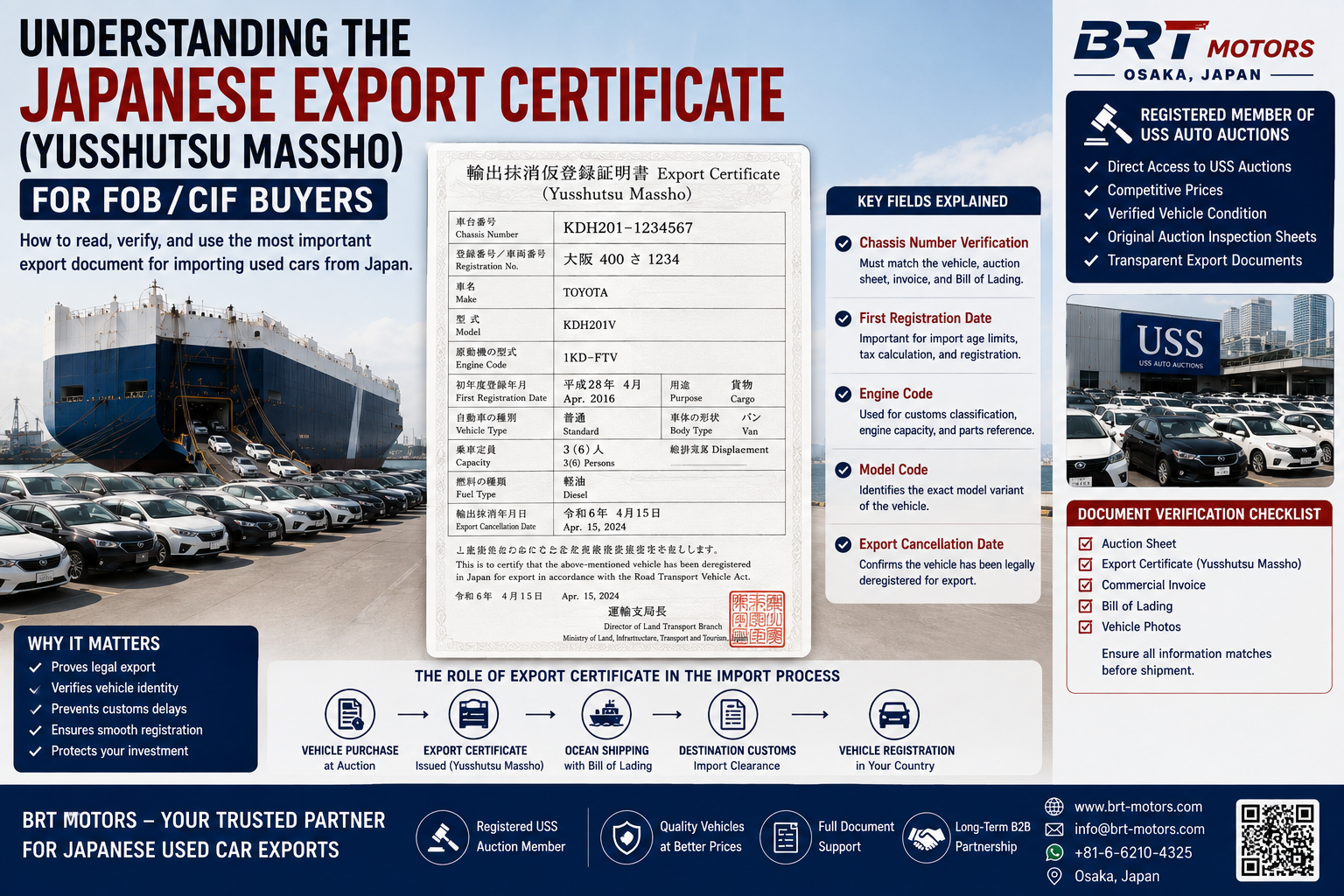
Learn how to read the Japanese Export Certificate (Yusshutsu Massho), verify chassis numbers, first registration dates, engine codes, and avoid document problems when importing used cars from Japan.
Understanding the Japanese Export Certificate (Yusshutsu Massho) for FOB/CIF Buyers
For overseas car dealers, the Japanese Export Certificate (Yusshutsu Massho) is one of the most important documents in the entire import process.
Whether you buy under FOB or CIF terms, this document is often required for:
Customs clearance
Vehicle registration
Tax assessment
Ownership verification
Chassis number confirmation
Many first-time buyers focus on the auction sheet and photos, but experienced importers know that document verification is just as important as vehicle condition.
This guide explains how to read the Japanese Export Certificate, which fields matter most for B2B buyers, and how professional exporters help ensure that the vehicle and documents match correctly.
What Is the Japanese Export Certificate (Yusshutsu Massho)?
Export Certificate (Yusshutsu Massho)
The Yusshutsu Massho is the official Japanese document issued when a vehicle is deregistered for export.
It confirms that the vehicle has been legally removed from the Japanese registration system and is eligible for export.
For most importing countries, this is the primary source document used to verify the vehicle’s identity.
Why It Matters for FOB and CIF Buyers
Under both FOB and CIF transactions, the buyer eventually relies on the export certificate to prove:
The vehicle exists
The chassis number is correct
The registration history is consistent
The engine information is correct
The vehicle is not using a mismatched identity
If there is a discrepancy between the export certificate and the physical vehicle, customs or registration authorities may delay or reject the process.
The Most Important Fields on the Export Certificate


5
1. Chassis Number Verification
Chassis Number Verification
This is the single most important check.
The chassis number on the export certificate must match:
The vehicle body
The auction sheet
The Bill of Lading
The commercial invoice
Example format:
KDH201-1234567
Professional dealers should compare every character, not just the first few digits.
Common Mistakes
Missing digit
Letter/number confusion (O vs 0, I vs 1)
Typing errors on invoices
Truncated chassis numbers
Even a small mismatch can create customs problems.
2. First Registration Date
First Registration Date
This field shows when the vehicle was first registered in Japan.
It is often used for:
Import age limits
Tax calculation
Registration eligibility
Market valuation
The date is usually written in the Japanese calendar system.
Japanese Calendar Conversion
| Japanese Era | Gregorian Year |
|---|---|
| Reiwa 1 | 2019 |
| Reiwa 2 | 2020 |
| Reiwa 3 | 2021 |
| Heisei 30 | 2018 |
| Heisei 29 | 2017 |
If you are unsure, ask the exporter for a translated copy.
3. Engine Code
Engine Code
The engine code is important for:
Customs classification
Parts ordering
Technical verification
Engine-size confirmation
Examples:
1KD-FTV
1GD-FTV
2ZR-FXE
Do not confuse the engine code with the engine serial number.
Why Customs Checks the Engine Information
In some countries, taxes depend on:
Engine displacement
Fuel type
Vehicle category
An incorrect engine code can lead to:
Wrong duty assessment
Registration delay
Additional inspection
4. Vehicle Model Code
This identifies the exact model variant.
Examples:
KDH201
GDH201
ZRE142
TRH200
The model code is often more accurate than the commercial model name.
5. Color and Body Type
These fields are usually secondary, but they help confirm that the document belongs to the correct vehicle.
How to Read a Typical Export Certificate
A simplified interpretation:
Vehicle: Toyota HiAce
Model: KDH201V
Chassis: KDH201-1234567
Engine: 1KD-FTV
First Registration: Heisei 28 (2016)
Export Cancellation Date: 2026
This is the information dealers should verify against all other shipment documents.
Document Verification Checklist for Car Dealers
Before paying the balance or releasing shipping documents, compare:
| Document | What Must Match |
|---|---|
| Auction Sheet | Chassis, model, mileage |
| Export Certificate | Chassis, engine, registration date |
| Commercial Invoice | Chassis, vehicle description |
| Bill of Lading | Chassis, consignee |
| Vehicle Photos | Physical vehicle identity |
This is the core of export document verification for car dealers.
Auction Sheet vs Export Certificate
These documents serve different purposes.
| Auction Sheet | Export Certificate |
|---|---|
| Condition report | Legal identity document |
| Mileage information | Registration information |
| Damage notes | Chassis verification |
| Interior/exterior grade | Engine and model code |
A clean auction sheet does not replace a valid export certificate.
Common Red Flags
Chassis number differs from auction sheet
Stop and verify immediately.
First registration date differs from invoice
May affect import eligibility or taxes.
Engine code missing or altered
Request clarification before shipment.
Low-quality or cropped document image
Ask for a full scan.
Handwritten corrections
Require explanation and supporting documents.
Why Professional Dealers Request a Translation
The original document is in Japanese.
A translated copy helps:
Customs brokers
Registration officers
Bank document review
Internal accounting
Fleet management
However, the Japanese original remains the controlling document.
What is Yusshutsu Massho?
Yusshutsu Massho is the official Japanese export certificate issued when a vehicle is deregistered for export. It confirms the vehicle’s legal identity and export eligibility.
How do I verify a Japanese export certificate?
Check that the chassis number, model code, engine code, and first registration date match the auction sheet, invoice, Bill of Lading, and the physical vehicle.
Why is the first registration date important?
Many countries use it to determine import age limits, taxes, and registration eligibility.
How BRT Motors Handles Document Verification
BRT Motors is headquartered in Osaka, Japan and is a registered member of USS Auto Auctions.
We supply vehicles to:
Used car dealers
Wholesalers
Fleet operators
Rental companies
Automotive traders
Because we purchase directly from the USS auction network, we can provide consistent vehicle and document verification for B2B buyers.
Our Verification Process
Original Auction Inspection Report
Provided for every vehicle.
Chassis Cross-Check
We compare the chassis number across auction, export, and shipping documents.
Pre-Export Verification
The physical vehicle is checked against the documentation before shipment.
Clear Export Documentation
We provide the export certificate and related shipping documents in a format suitable for overseas processing.
Our goal is to reduce document-related disputes and help dealers clear and register vehicles more smoothly.
Why This Matters for Long-Term B2B Trust
In wholesale trading, a single document problem can damage a business relationship.
Professional buyers are not only purchasing a vehicle; they are purchasing:
Correct identity
Correct registration history
Correct export documents
Correct shipment information
This is why experienced dealers often value document transparency as much as price.
Frequently Asked Questions
What is the Japanese Export Certificate?
It is the official deregistration document issued when a vehicle is prepared for export from Japan.
How do I read Yusshutsu Massho?
Focus on the chassis number, first registration date, engine code, and model code.
Which document is more important, the auction sheet or the export certificate?
For legal identity and registration, the export certificate is more important. For condition and mileage assessment, the auction sheet is essential.
Can customs reject a vehicle because of a chassis mismatch?
Yes. Any discrepancy between the export certificate and the physical vehicle or shipping documents can cause delays or rejection.
Why choose BRT Motors?
BRT Motors is a registered USS auction member in Osaka, Japan. We provide direct auction sourcing, original inspection reports, chassis cross-checks, pre-export verification, and transparent export documentation for professional car dealers.
Conclusion
The Japanese Export Certificate (Yusshutsu Massho) is not just a formality—it is the legal foundation of your imported vehicle.
Every professional dealer should verify:
Chassis number
First registration date
Engine code
Model code
Consistency across all documents
Understanding these fields helps prevent customs delays, registration problems, and costly disputes.
With direct access to USS Auto Auctions, transparent documentation, and systematic pre-export verification, BRT Motors helps overseas dealers import Japanese vehicles with greater confidence, accuracy, and long-term business security.
About BRT Motors
BRT Motors is a professional Japanese used vehicle exporter based in Osaka, Japan.
As a registered member of USS Auto Auctions, we provide:
Direct auction sourcing
Competitive wholesale pricing
Original auction inspection reports
Chassis and document verification
Pre-export condition verification
FOB and CIF export support
Complete export documentation
Long-term B2B partnership support
We are committed to helping dealers worldwide build transparent, reliable, and profitable Japanese vehicle import operations.